Common questions

Permanent Lighting FAQ

Worth it? If you want your roofline lit on more nights than a few in December, yes. A permanent system lights the house every night you choose, in whatever color suits the night, and nobody climbs a ladder for it again. Our installers put it up, and the system is looked after from there. The questions homeowners ask before they say yes are all answered below, in full.

Get A Free Lighting Estimate

Free, no ladder, and nothing to sit through.

Quick answers
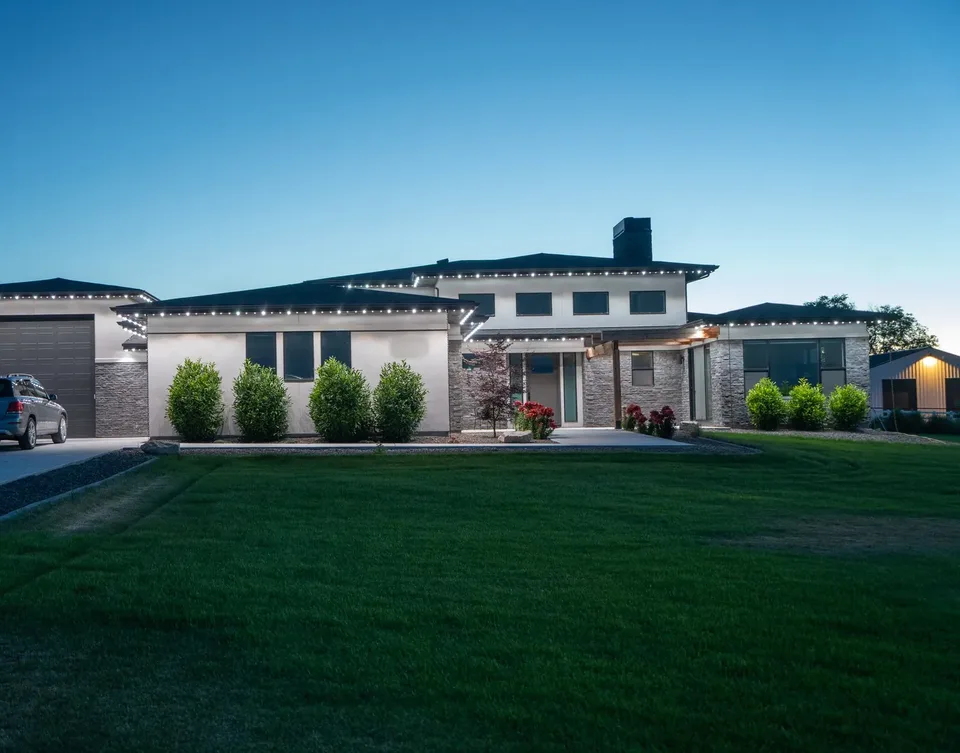
A large house at twilight with every eave and gable outlined in cool white light, the sky still deep blue behind it.
Chapter 01

Is it worth it?

The question everybody arrives with. The short version: it is worth it if you want your house lit on ordinary nights, and the photographs on this page are the argument.

Are permanent Christmas lights worth it?

Yes, for a Nashville house you want lit well beyond December: permanent Christmas lights go up once, nobody hangs or takes down strings again, and at 6 to 12 hours a day the system works out to about 10 to 20 years.
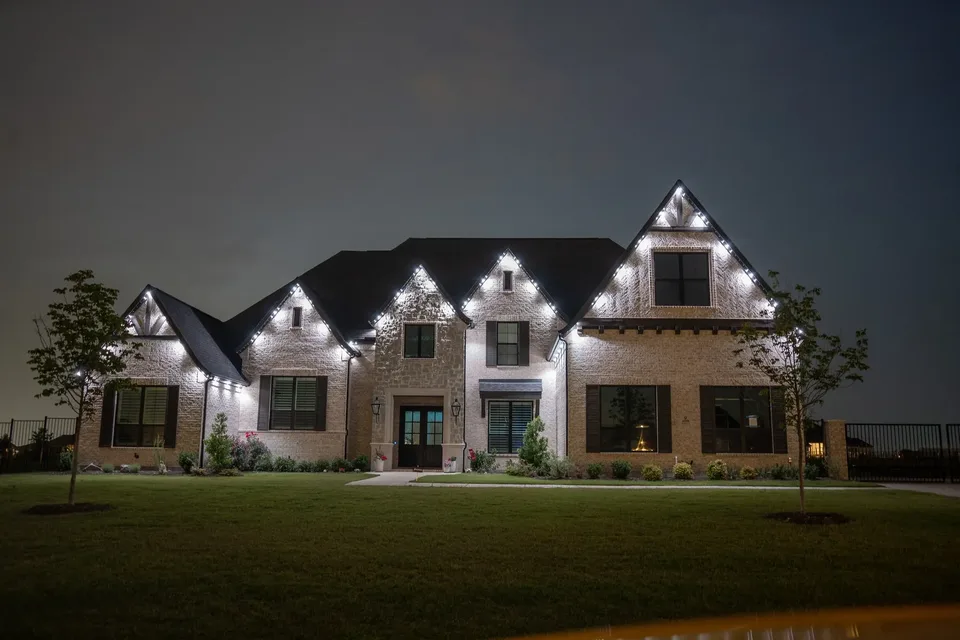
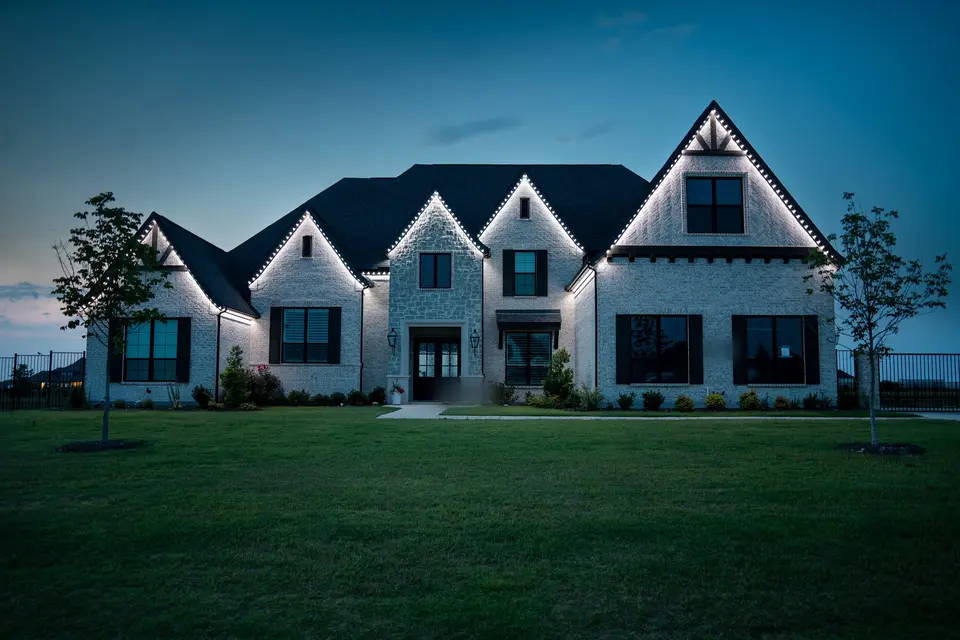
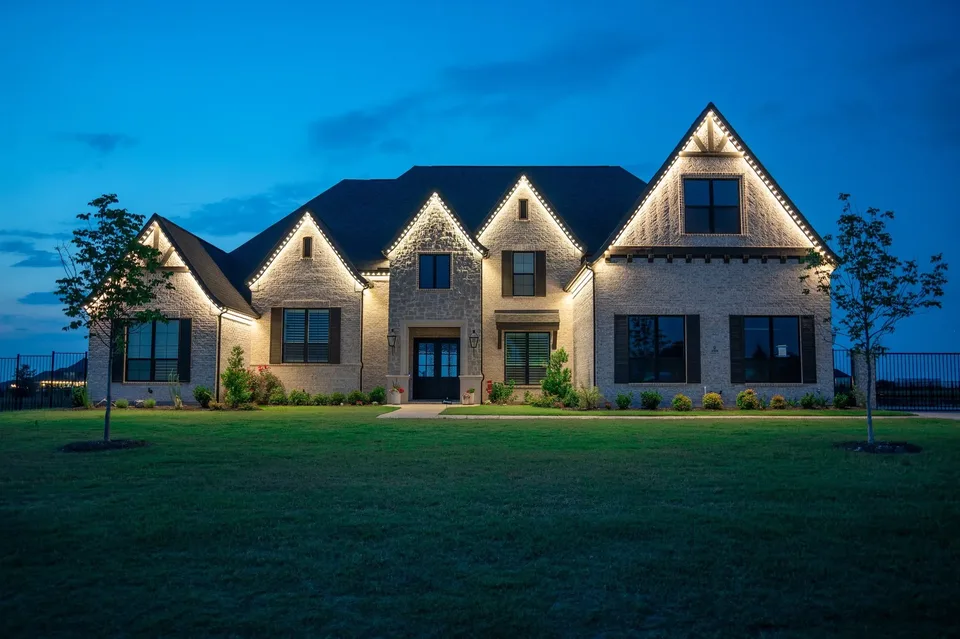
A white brick house at night with every gable and eave outlined in crisp bright white light.

Worth it on the first ordinary weeknight you pull into the driveway and the house is already lit. December is the excuse, not the reason. Ask it this way: how many nights a year do you want your house lit? If the answer is thirty, you are buying a Christmas decoration. If the answer is most of them, you are buying permanent lighting for your home that happens to do Christmas as well, on the same hardware, with nothing to put up and nothing to take down.

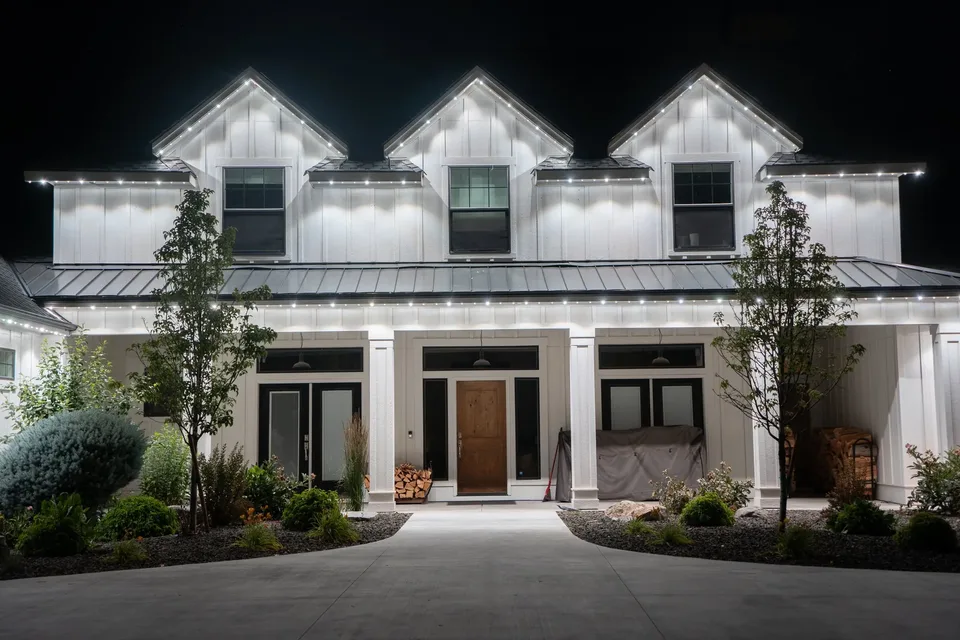
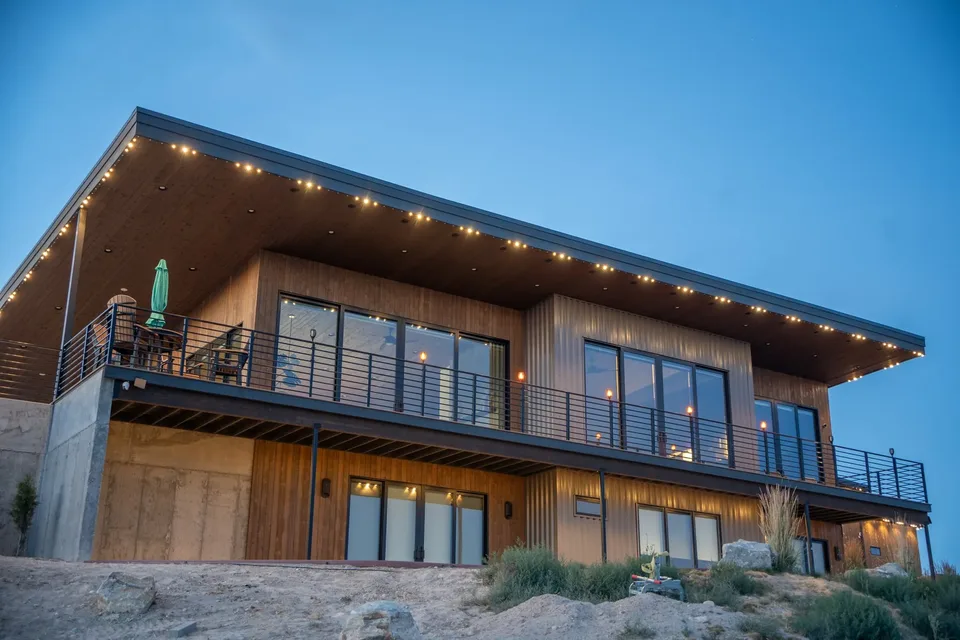
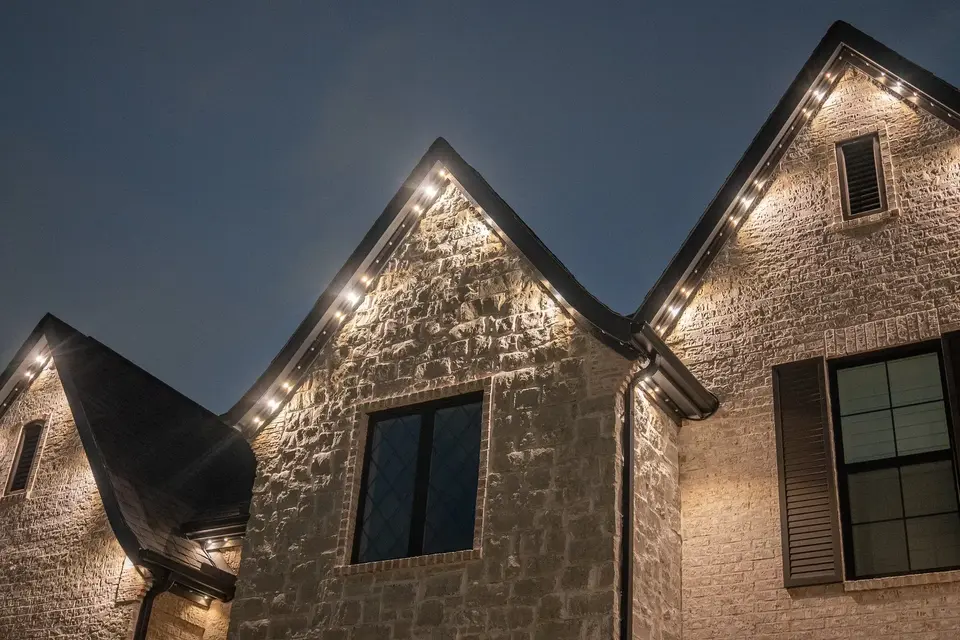
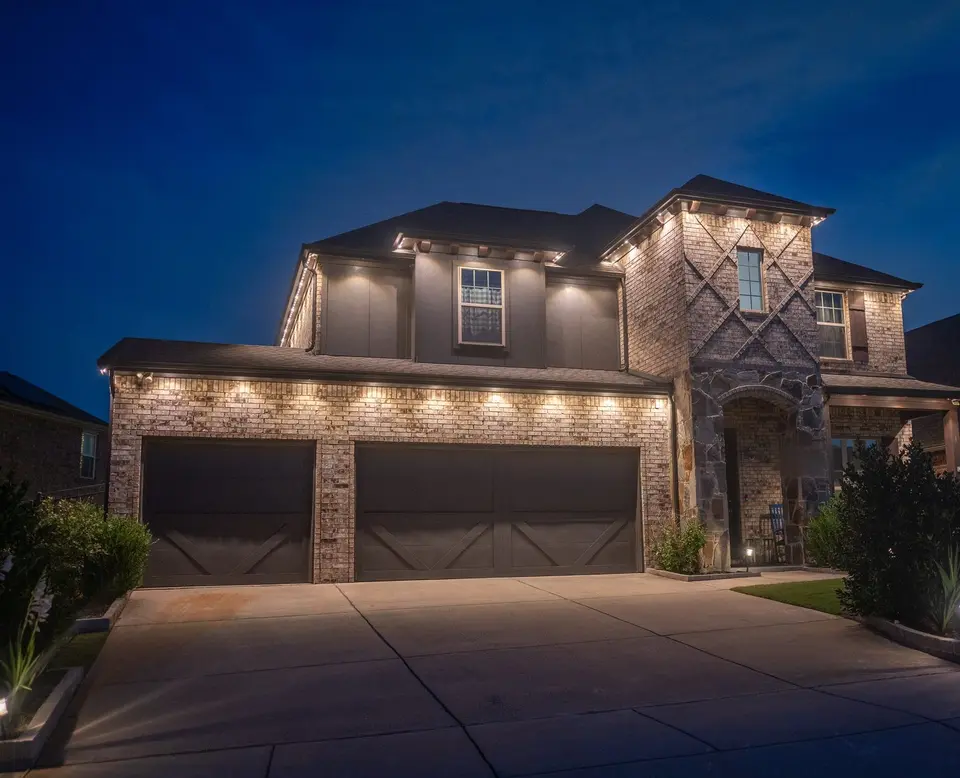
Every photograph on this page is a real house with this system on it, and that is the whole argument. Warm white along the eaves is what makes a house read as looked after from the street. The same run goes red and green for three weeks in December, then back to warm white in January while you do nothing at all. Nobody who has lived with it goes back to a dark roofline.

The only way to know what it does to your house is to get your roofline looked at in person. Ask for a free estimate and the installers will tell you what yours would take.
Do I still have to put lights up every year?

Never again. That is the part you are really buying.

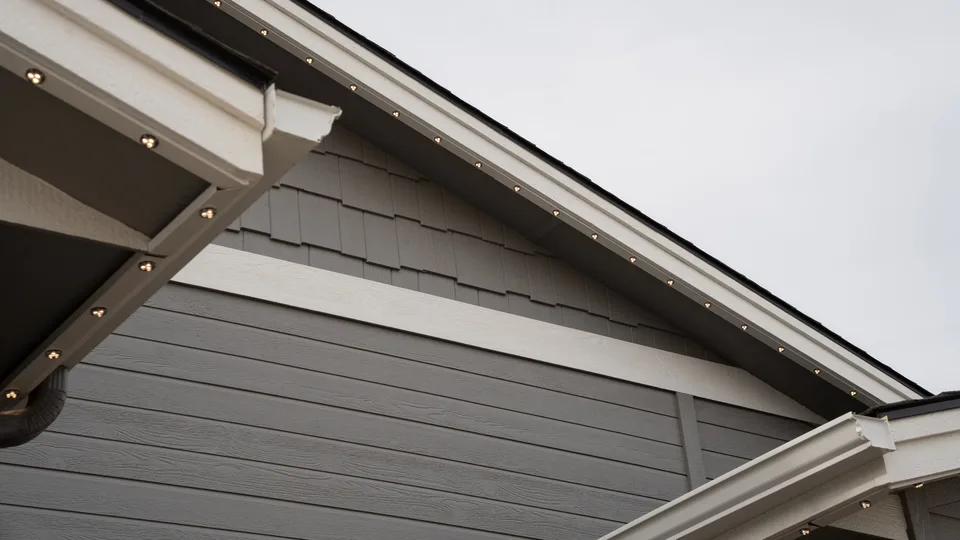
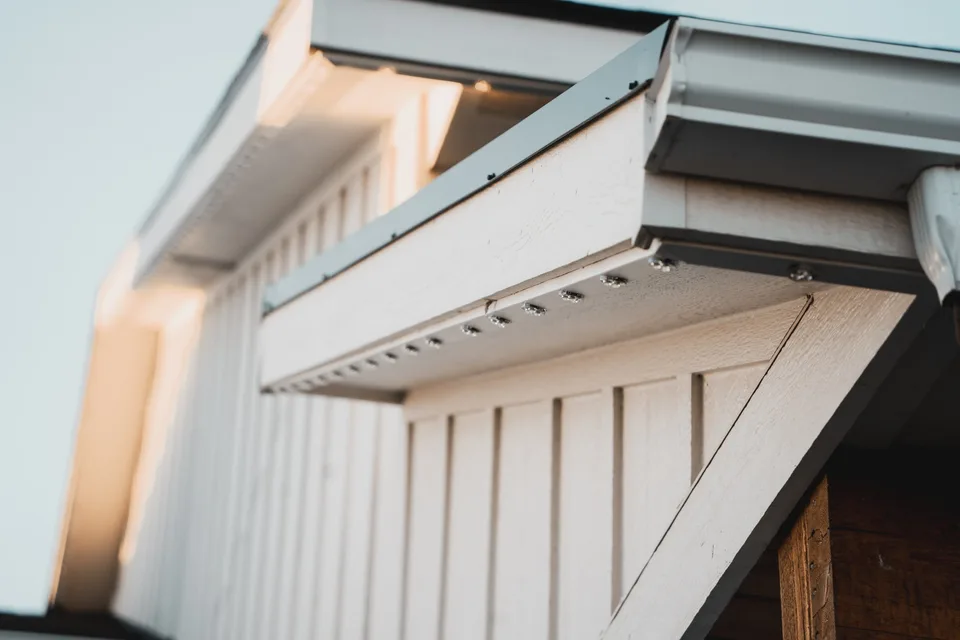
The underside of an eave in daylight, with the slim channel fitted along it and the points inside unlit.

The install happens once. A slim channel follows the eave, the lights sit inside it, and it is on the house in June exactly as it is in December. No ladder in the cold, no clips, no extension cords across the roof, no box in the attic, and no Saturday in January taking it all back down again.

There is a harder version of the same argument and it is worth reading once. The Consumer Product Safety Commission counts about 160 Christmas decorating-related injuries a day during the season, with nearly half of them involving falls, and about 14,900 emergency room visits across the 2023 season. That count covers holiday decorating generally, trees and wreaths included, rather than light-hanging alone. Read it as the background risk of climbing around a house in winter, and then subtract yourself from it permanently.

The channel that makes that true is in the photographs beside these answers. If you want to see it on your own eave, ask us for a free estimate.

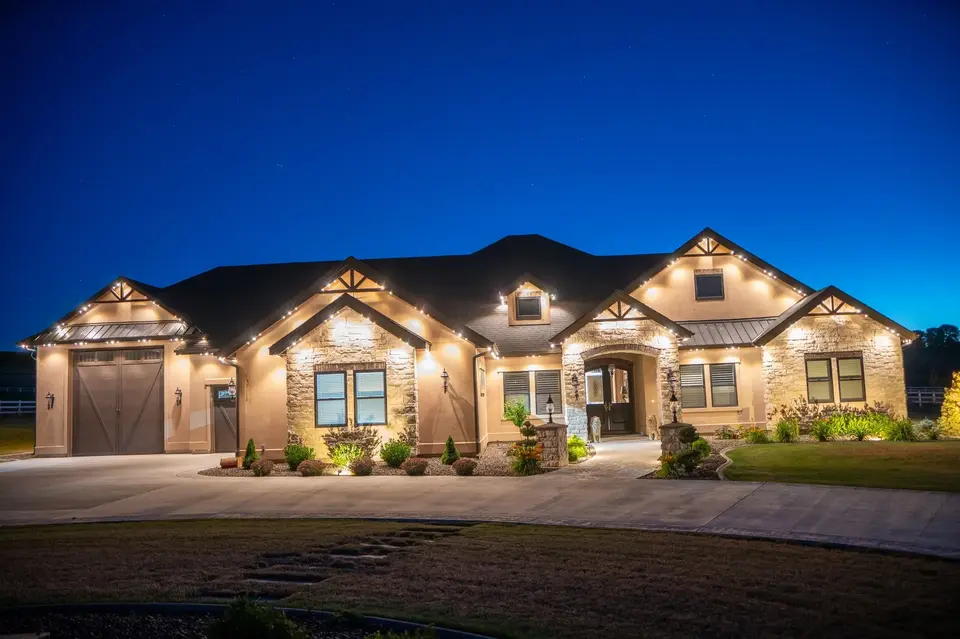
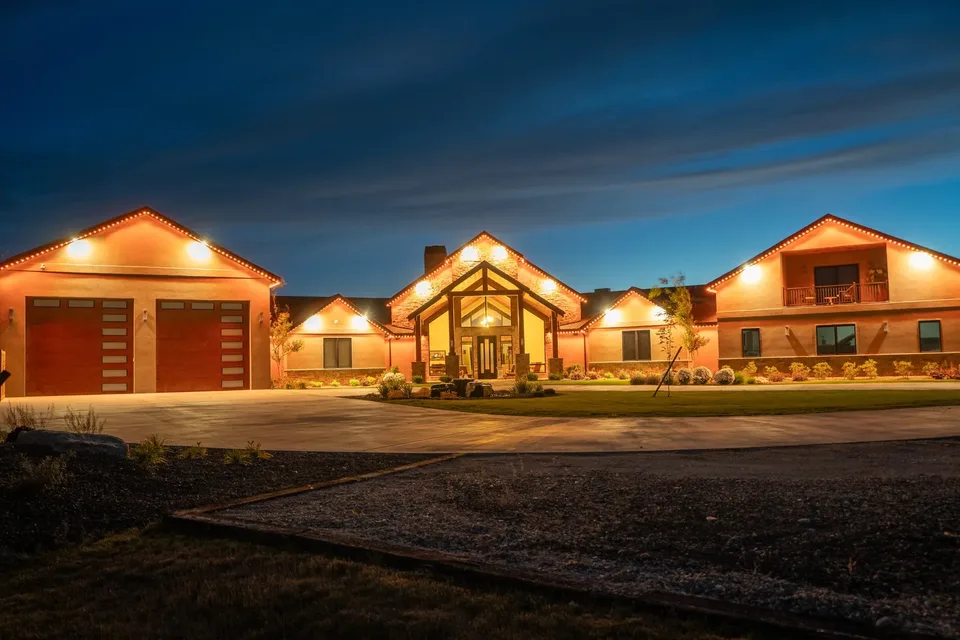
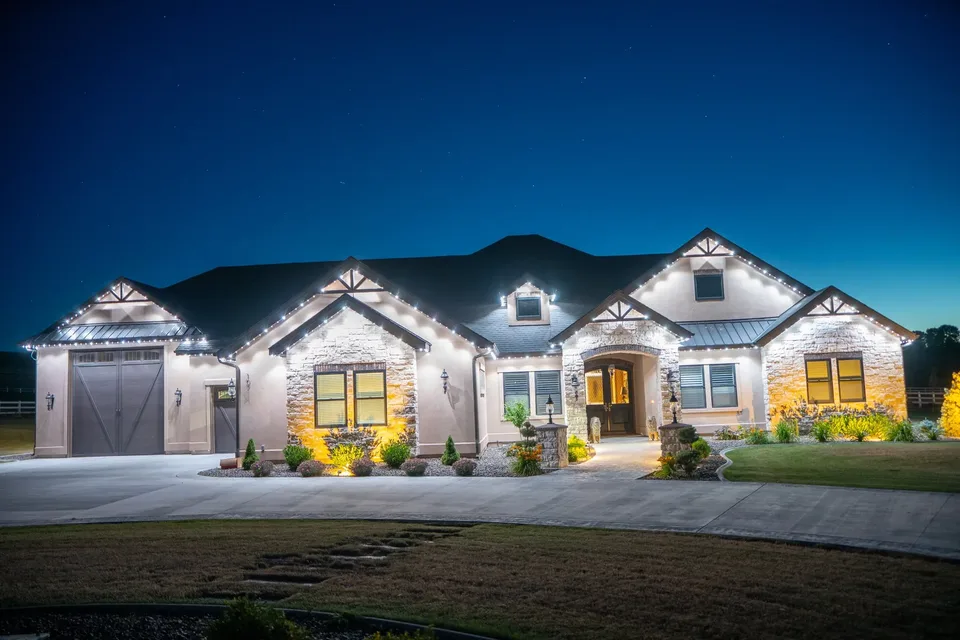
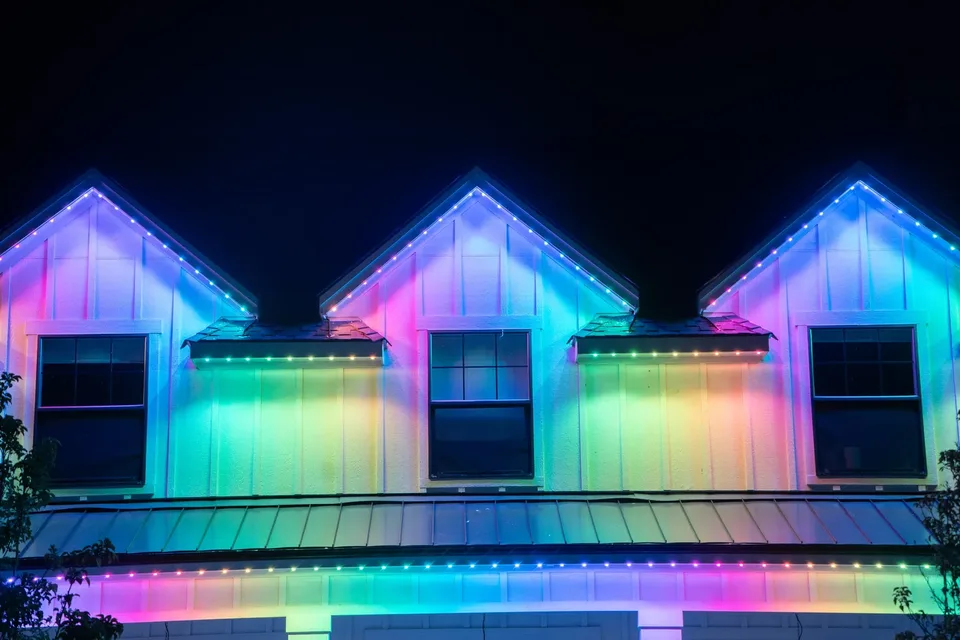
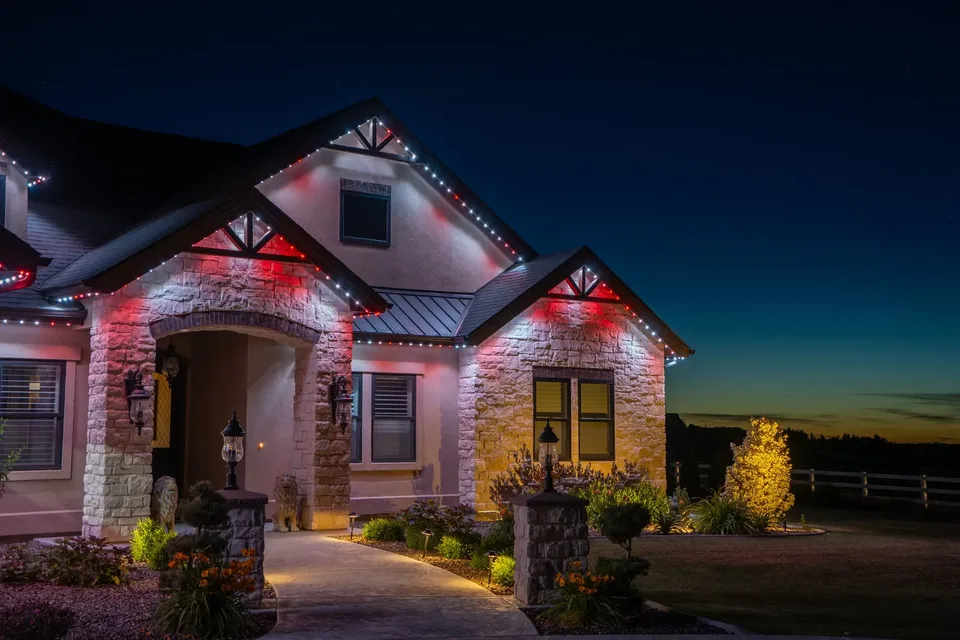
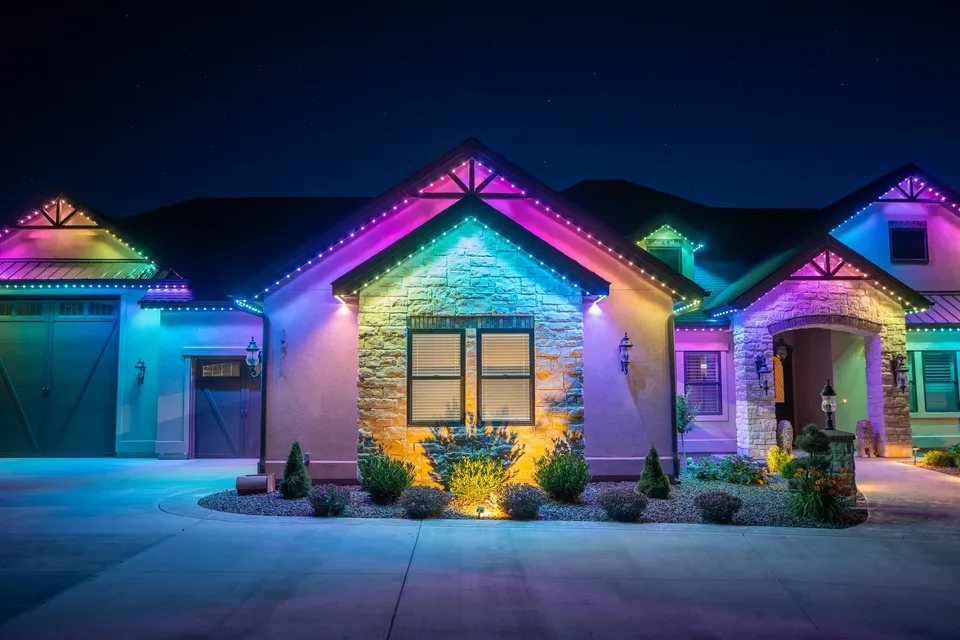
A stone and stucco house at night with every gable traced in points of light, blending pink, purple, teal and gold across the whole front.

Every night of the year, not six weeks of it.

Does Nashville allow Christmas lights to stay up all year?

Nashville's Metro Code says holiday lights and decorations "shall be permitted" on the exterior of buildings and in exterior property areas, kept "in good, functional condition" and not impeding "any ingress or egress."

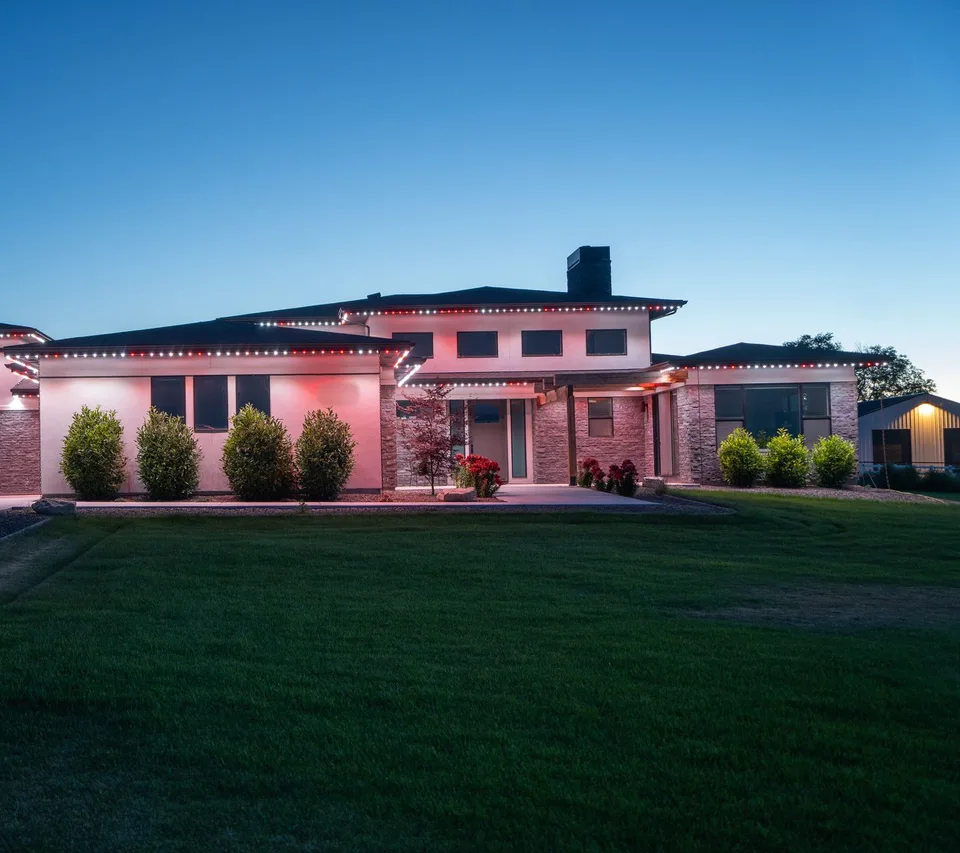
A broad stone and stucco house under a night sky, red and green points tracing each gable peak, the walls below washed in the same two colors.

The text says nothing about a season, a number of days or leaving lights up all year. It came from Ordinance BL2025-1071, passed November 4, 2025. The wording, its sources and the date checked, October 8, 2026, are on the exterior lighting rules page.

Do permanent Christmas lights increase my home value?

A buyer decides how they feel about a house before they are out of the car, and the roofline is the part they see first.

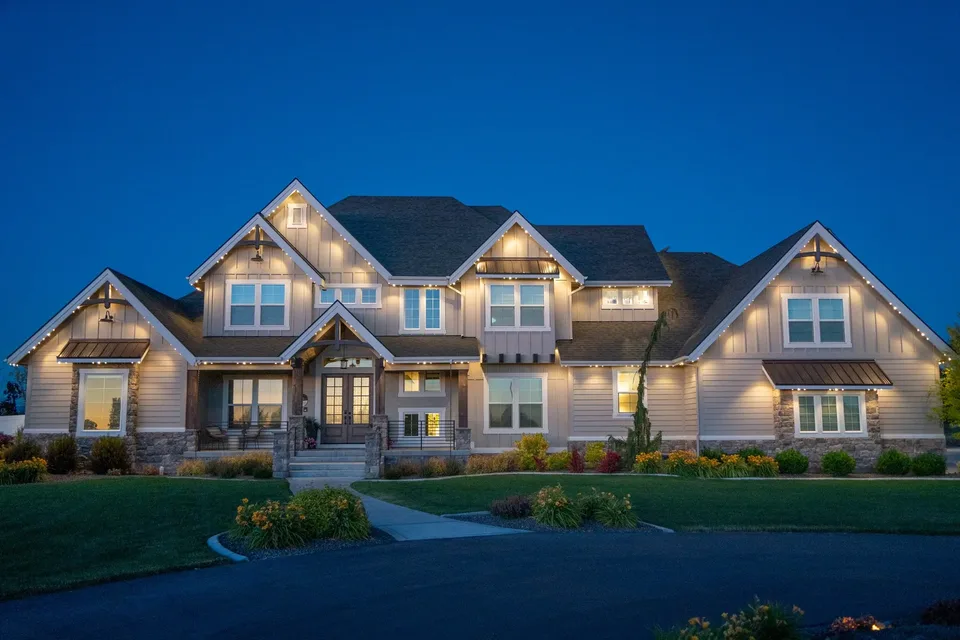
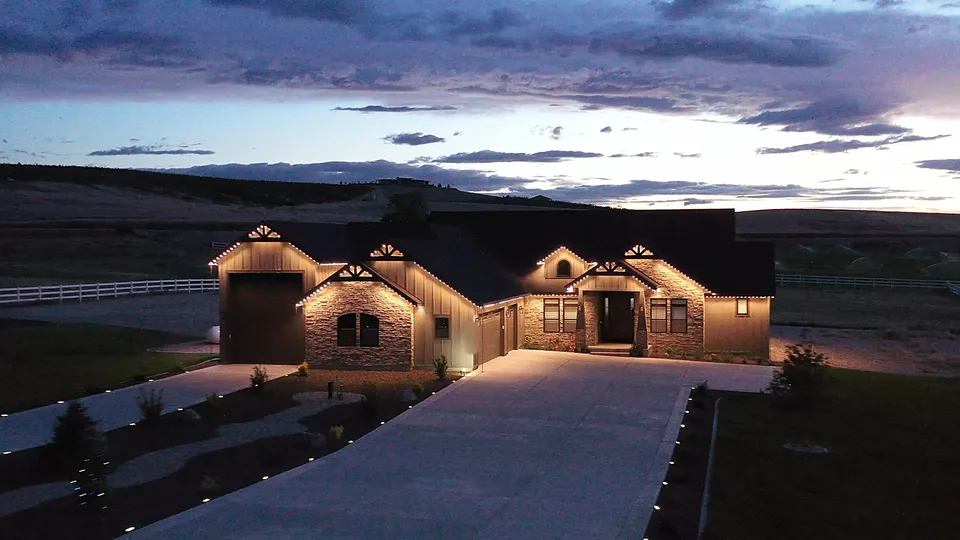
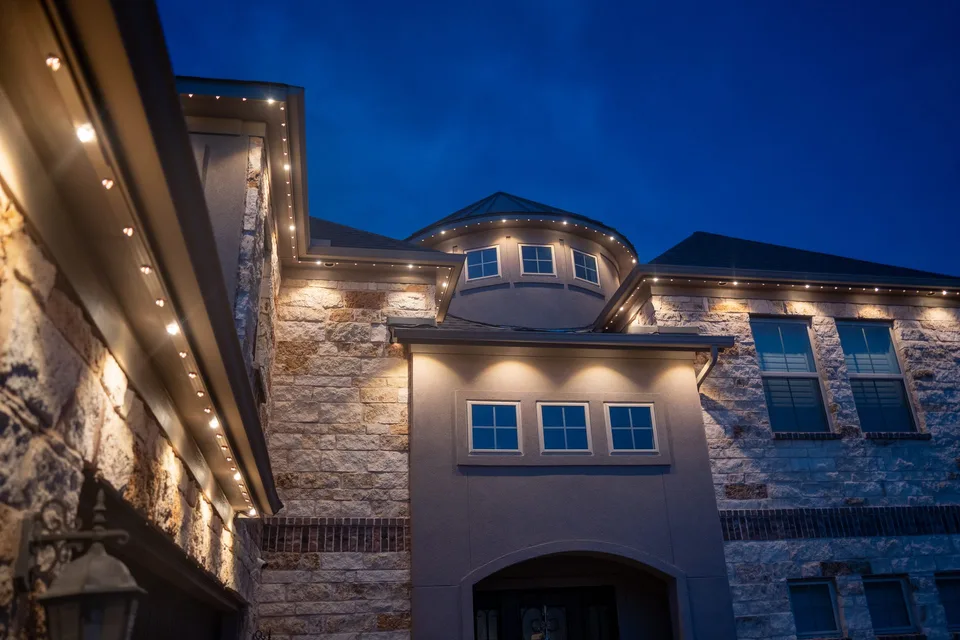
A large craftsman house at dusk, warm white light running along every eave and up each gable.

Start with the part you can see. At five in the evening in December, a dark roofline and a lit one are two different houses on the same street, and the lit one is the one people slow down for. Realtors say the same thing in print: outdoor lighting, in their words, serves style, ambiance, safety and, for home sellers, serious curb appeal.

The National Association of Realtors studied outdoor projects and found landscape lighting recovered 59 percent of its cost at resale. A lit roofline is a different install, but it is aimed at the same thing: the part of the house a buyer sees first.

Two more numbers from the same report are worth your time. 11 percent of the realtors surveyed said they would suggest landscape lighting to a seller before listing, and 61 percent of owners who added landscape lighting said they had a greater desire to be home after it went in. That second one describes this purchase best: you will use it, you will like coming home to it, and it is not money you have thrown away. Get a free estimate for your roofline and decide with a real number in front of you.

Who is this really for?

Anybody who owns the house and is done with the ladder. If you already pay for lights every year, it is you.

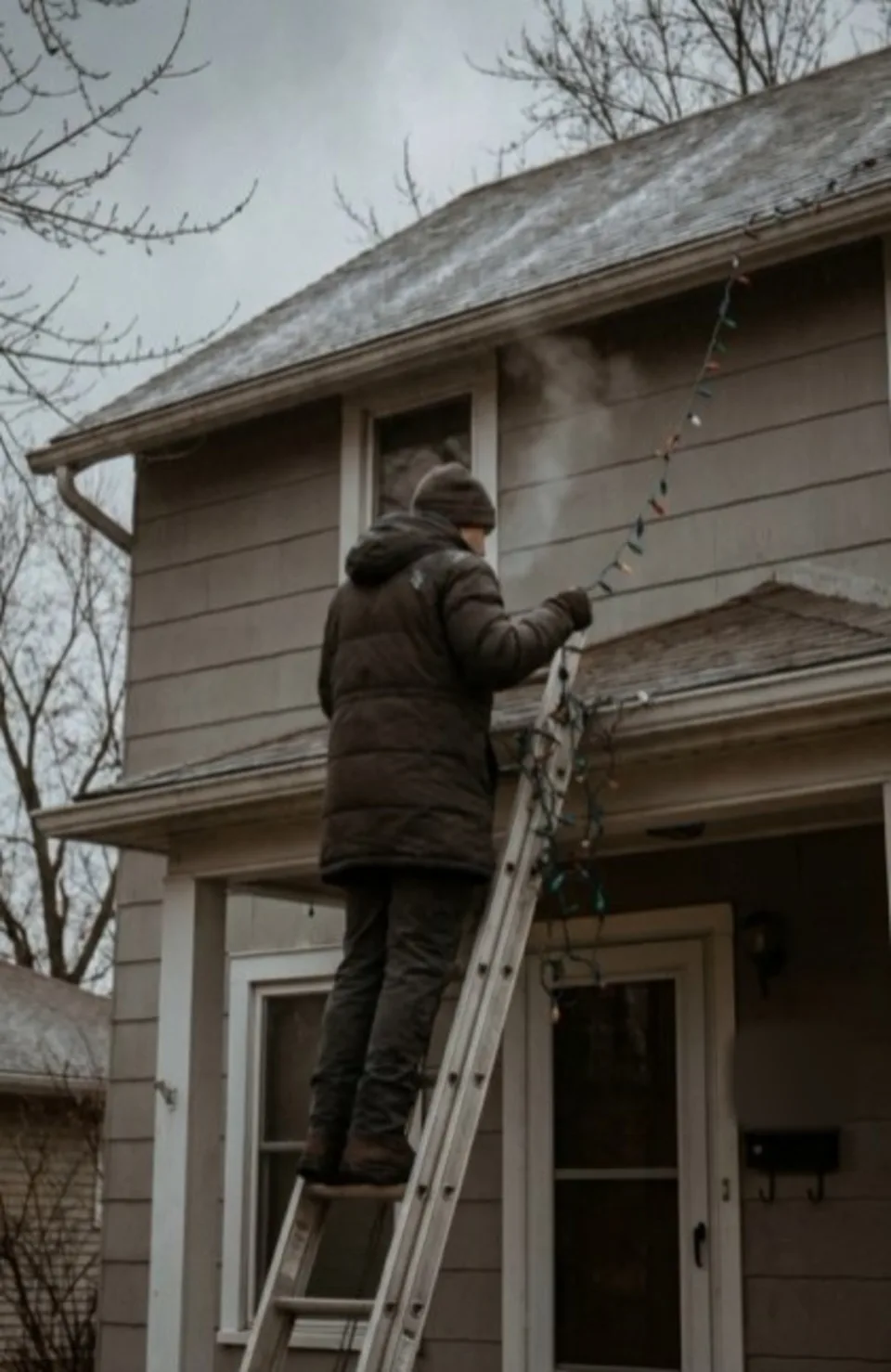
A person at the top of an extension ladder in winter, clipping a string of lights along a roof edge.

It is for the homeowner who spent one December Saturday at the top of a ladder with cold hands and decided once was enough, and for the one who writes a check every November so somebody else can climb it, then writes the same check the next year.

Both of them are already paying for lights every single year. One way, the money ends up as a system on the house that lights it every night you want. The other way, it ends up as a receipt and a dark roofline by February. Find out what your own roofline would take. The estimate costs nothing.
How is this different from paying someone to hang lights every year?

One install instead of a booking every November, and a lit house the other ten months instead of a dark one.

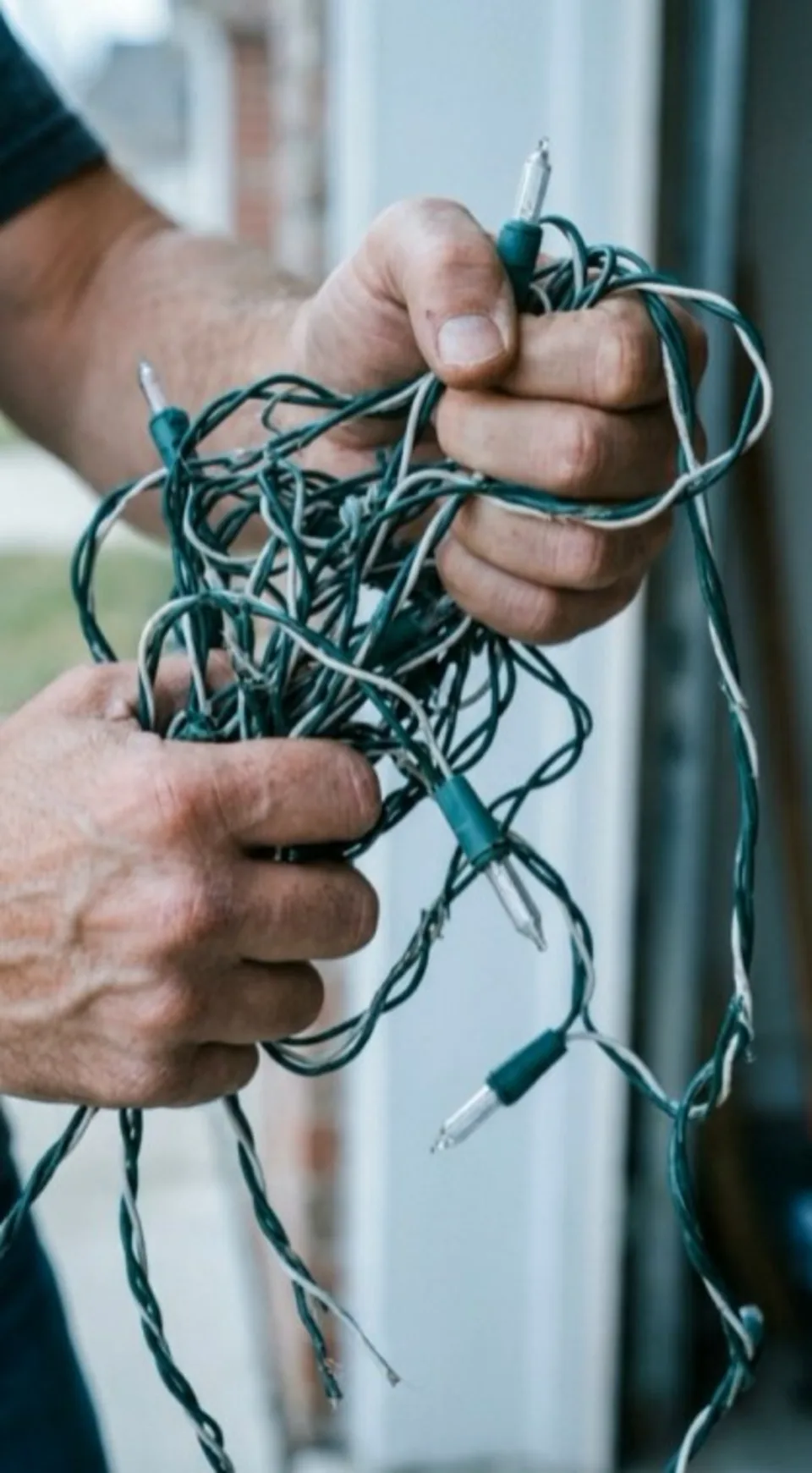
Two hands holding a knotted bundle of seasonal string lights pulled out of storage.

A seasonal install is a string of lights clipped to your fascia in late autumn and pulled back off in January. You pay for it again next year, you book it in the one month everybody else is booking it, and for the other ten months there is nothing on the house at all. This is fixed to the building once: the channel stays, the lights stay, and what changes in December is a color you pick on your phone.

You pay for it once instead of a slice every winter, and what that buys is a house that is lit in March and a November where the only thing you do is tap a preset. The long comparison, side by side, is the seasonal option set beside this one.

If you have a seasonal quote in your hand right now, that is the best possible moment to get our estimate beside it: ask for a free estimate.

What happens if I sell the house?

It stays with the building, and it is the first thing a buyer sees at an evening showing.

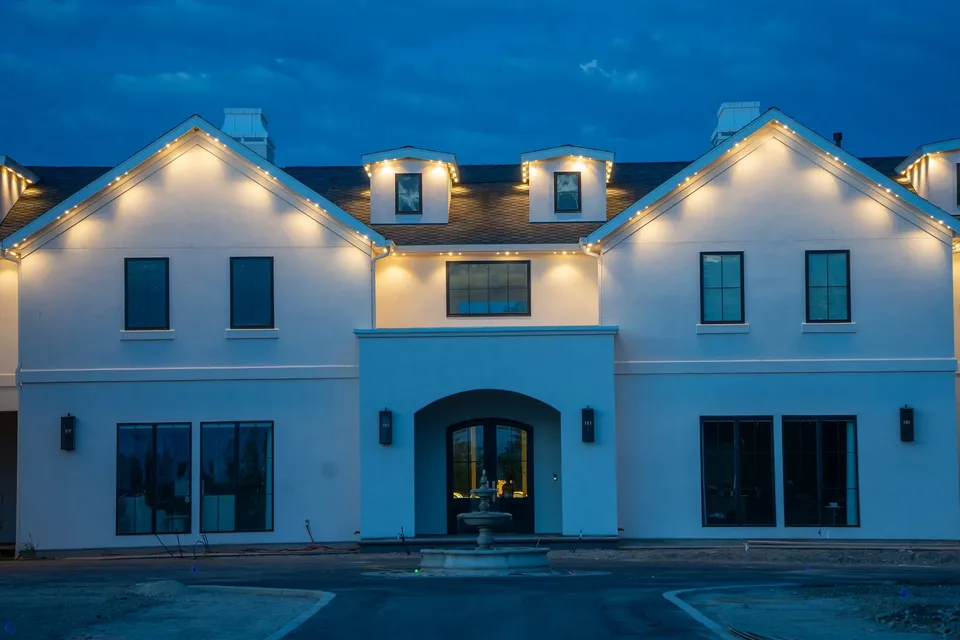
A white stucco house with a fountain courtyard, lit warm white along the roofline after dark.

The channel is fastened along the fascia and the soffit and the run goes back to a control box inside. None of that is built to come off, so it is part of the house the way a soffit light or a run of trim is part of the house. What a buyer sees walking up at dusk is a home with its exterior lighting already done, which realtors describe, in their own words, as serious curb appeal for a seller.

The numbers realtors put on outdoor lighting at resale are in the home value answer, a few questions up. If the money rather than the light is what you are weighing, what it costs is the page for that.

And if you are lighting the house to sell it, the timing matters more than usual, so get the estimate started now.

Chapter 02

What it looks like

The question everyone asks is whether it looks tacky. Here is the answer, in daylight and after dark, in photographs of real houses.

Both hours, from the street
A long run of slim channel following a rake board in daylight, reading as a trim line along the roof edge.
By day the channel passes for trim.
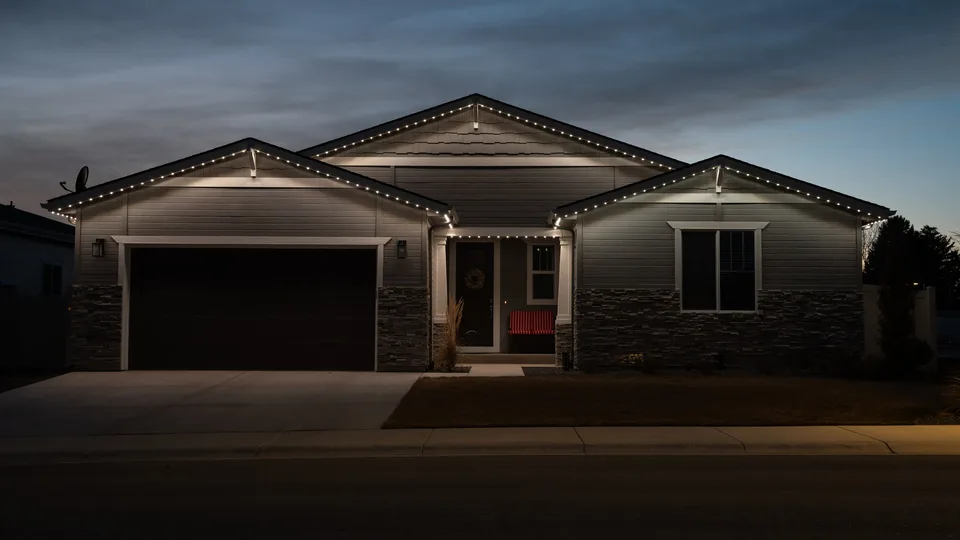
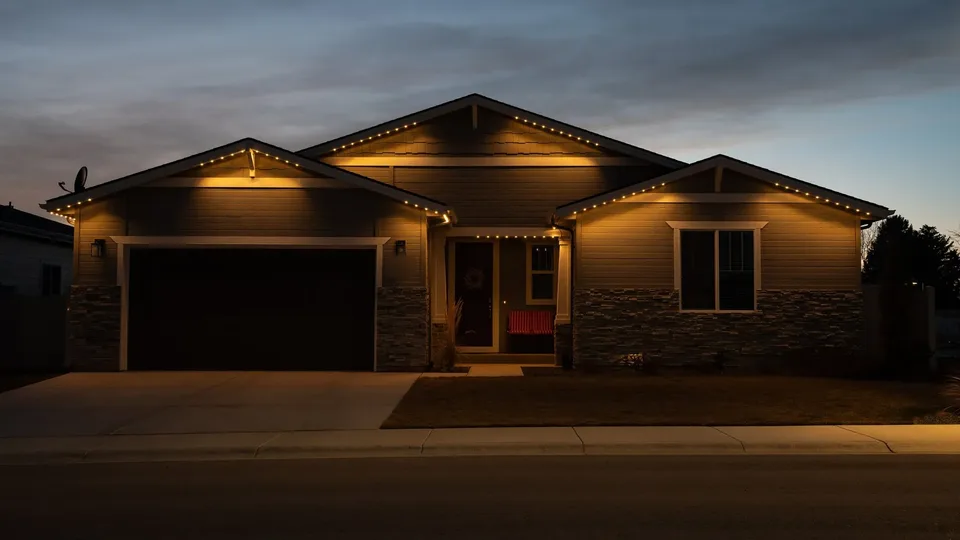
A single story house after dark, the whole roofline holding an even warm white.
After dark the whole roofline is lit, and nothing was hung.

Do permanent Christmas lights look tacky?

Not on a well-fitted roofline. Tacky comes from a mismatched channel or a garish setting, and the installers match the channel to your trim before anything is ordered.

A long house holding a single restrained warm white across the whole roofline, no color and no movement.

Two things make these look cheap and both are avoidable. The first is a channel that does not match the trim it is fixed to: a pale track on a dark fascia draws a line across the house in daylight and there is nothing to be done about it afterwards. The second is color with no restraint, which means six hues at once, a fast chase and everything at full brightness.

The same house on warm white, dimmed, holding still, reads as architectural lighting, and that is what almost every photograph on this page is. Restraint is a choice you make in the app. The system will do the tacky version perfectly well if you ask it to; it just never has to. The restrained end of it is on a page of real rooflines, in photographs rather than adjectives.

The half the installers control for you is the install, and it starts at the walkthrough: book a free estimate and our installers will pair the channel with your trim before anything is ordered.

What does it look like during the day?

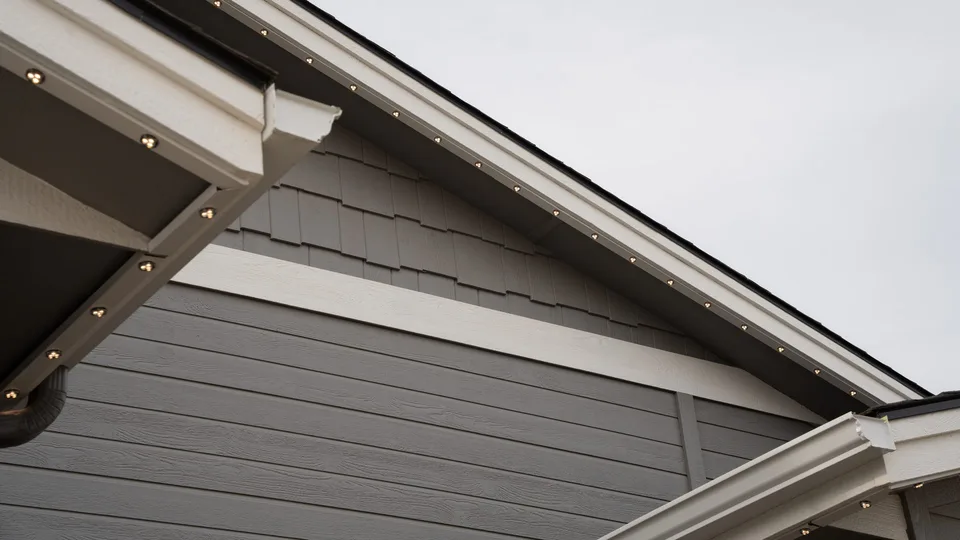
By day the install is basically invisible. No ugly holiday lights hanging all year.

The underside of an eave in daylight, the slim channel following it with the lights inside unlit.

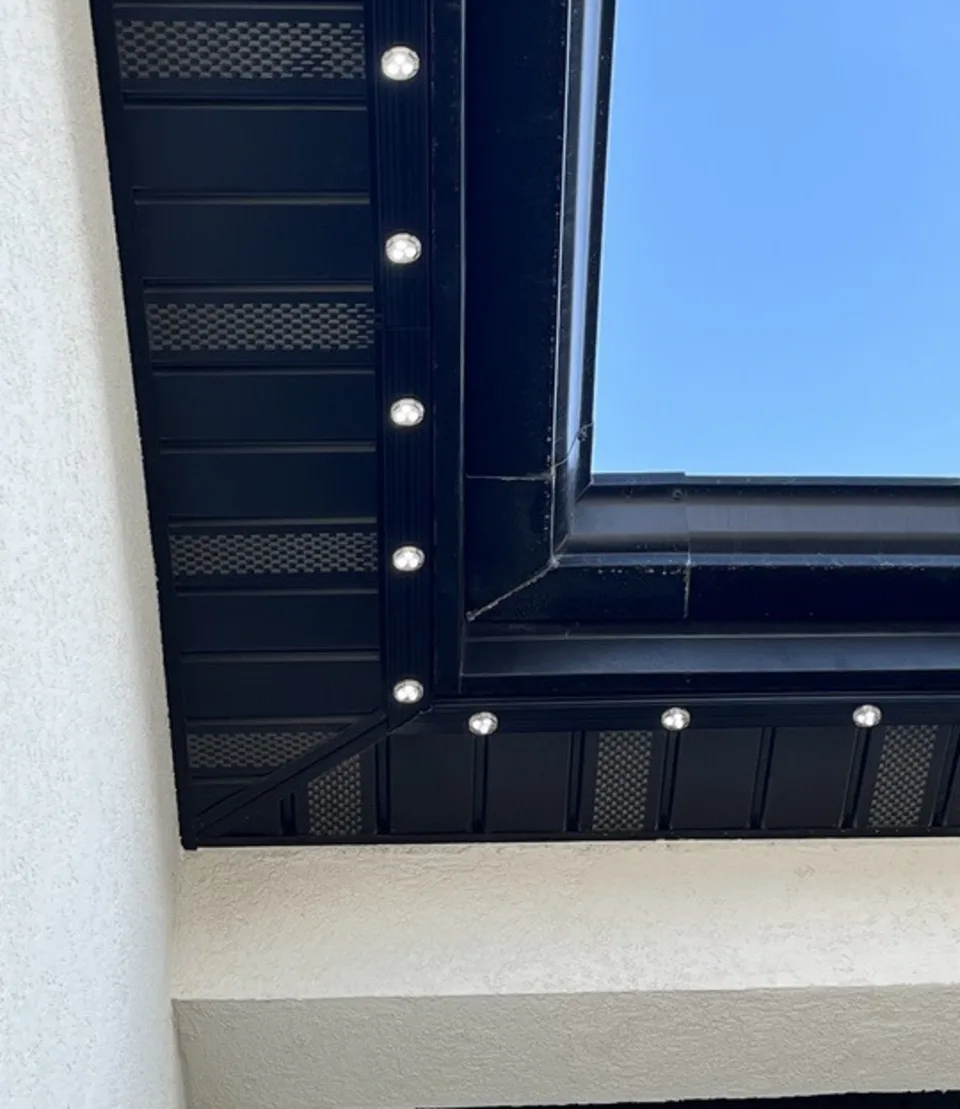
The hardware is a channel that follows the eave or fascia with the lights seated inside it, facing out and down. From the street, at the distance anybody actually looks at your house, it reads as a trim line in the color of your fascia, and nothing about it says Christmas lights.

The photographs beside these answers are daylight photographs for exactly this reason: that is the channel, on real houses, in the middle of the day. What is actually on the house has more of them, up close.

The version that matters is yours, on your fascia, in your trim color. Ask for a free estimate and see it against the house before you decide.

Will it match my roof and trim?

Yes, and it is the single most important decision about how this looks. The installers color match the channel to your house.

Channel in a dark bronze finish fitted against a dark soffit and roof edge, close up in daylight.

Channels are made in a range of finishes for exactly this reason, in three profiles for different roof edges, and the one that disappears is the one matched to the fascia or gutter it sits against rather than to the shingle above it. The installers match it to your house before anything is ordered, so what goes up reads as if it was built with the trim.

It is decided once. It costs nothing to get right at the start and it cannot be fixed later without pulling the run back off the building, which is the whole reason it is the first thing the installers look at on the walkthrough. The channel and the corners, close up is where to look at the finishes.

Bring your trim color to the walkthrough and one of our installers will bring you the match: get a free estimate.

What color does the channel itself come in?

Whatever your fascia is. It is matched to your house rather than picked off a chart.

The channel square on under a fascia in daylight, with three of the points visible inside it.

There are three profiles of channel for different structures and a range of finishes to match them into, and the useful question is never which colors exist. It is which one disappears against your trim, and that gets decided at the walkthrough with your fascia in front of the installers.

You see the exact finish going on your house before it goes on. What actually gets mounted has the channel on its own, in daylight.

That is a ten minute conversation on your driveway rather than a paragraph on a web page: ask for the free estimate.

Can my neighbors see it in the daytime?

They can see a line following your eave in the color of your fascia. They cannot see a bulb, a clip or a cord, because none of those is on the building.

A house seen from the curb at dusk, the roofline holding red and pink across one elevation.

Stand where a neighbor stands, on the sidewalk or the far curb, and what is visible is the same kind of line a roof edge or a run of soffit trim already draws. What is not visible from there is a bulb, a clip, an extension cord or a timer. In December, while every other house on the street grows a tangle of temporary wire, yours changes color.

This is the same answer what it looks like during the day gives, taken from the street instead of the roof. If you would rather judge it from photographs, houses in daylight is where those live.

Or judge it on your own house, from your own curb, with one of our installers standing there: free estimate.

Does it look like a gutter or a piece of trim?

Like a piece of trim by day and a line of light by night. That is the whole design.

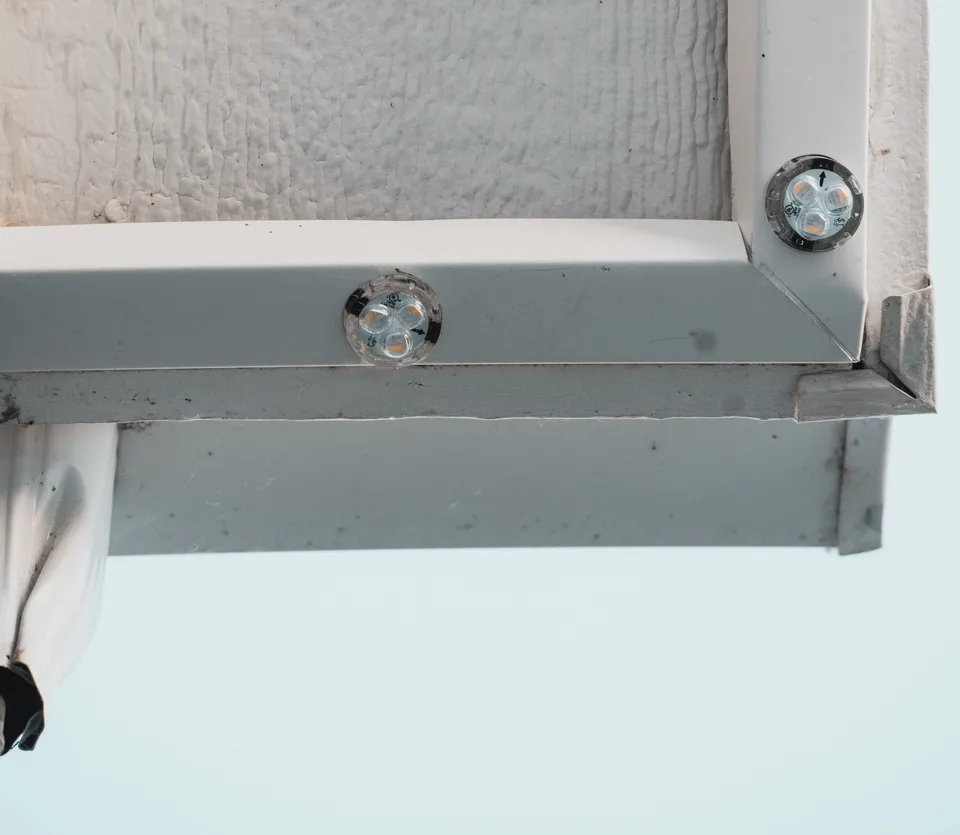
A mitered outside corner of the channel, with one light seated on each face of the corner.

The channel follows the edge your fascia already draws, in the color your fascia already is. Nothing bulges, nothing hangs off the front of it, and there is no seasonal version that goes up in November and comes down in January. It is one piece of trim that happens to light up.

It is not a gutter and it does not do a gutter's job. It is mounted along the fascia or soffit, off the part of the assembly that moves water, which is why whether it damages the roof matters as much as how it looks. What actually gets mounted on the house has it from a few feet away.

On your roof edge, that is a walkthrough question with a same-day answer: ask us for an estimate.

Can I run it white all year and never touch a color?

Yes, and that is what most houses are doing most of the time.

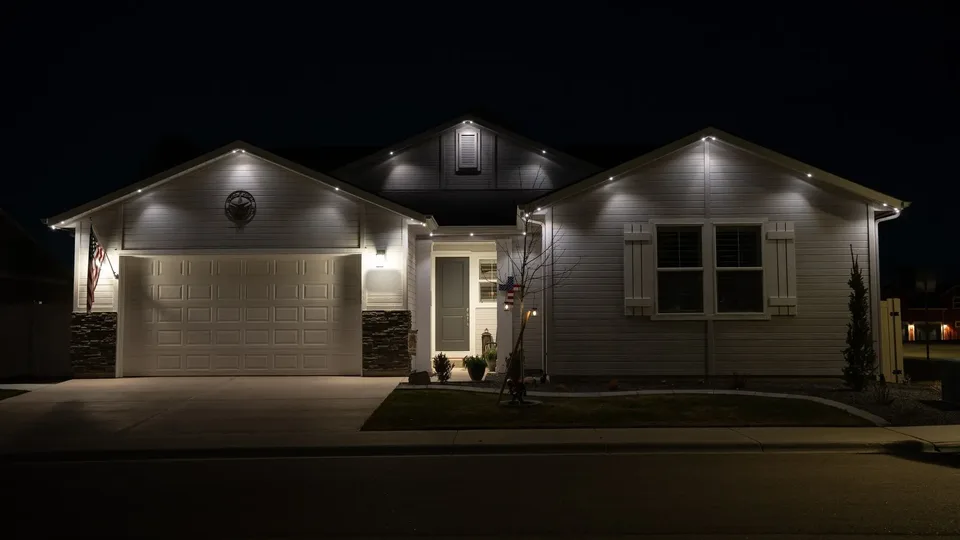
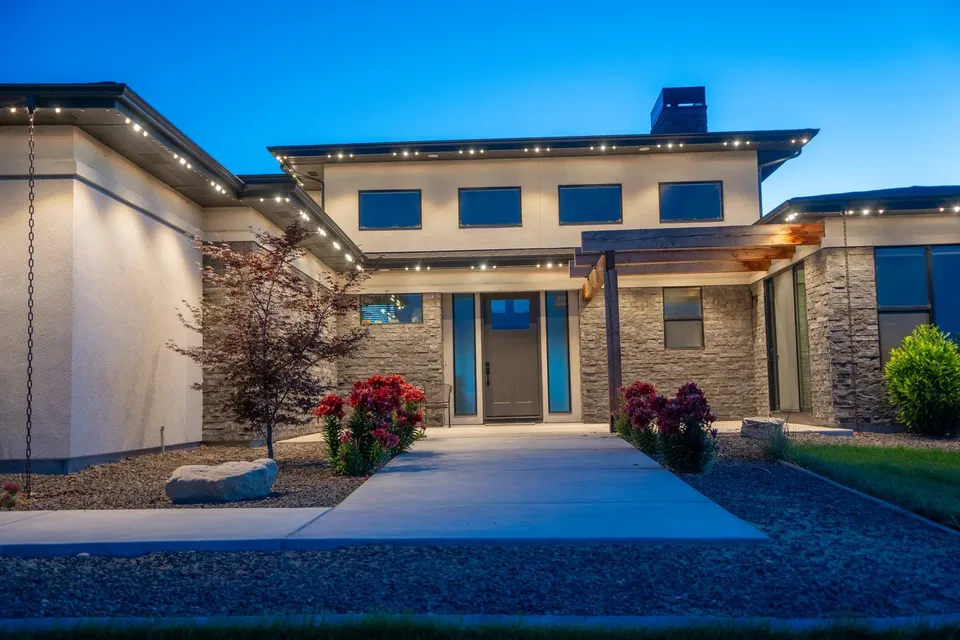
An ordinary single story ranch at night, warm white along the fascia and all three gables.

Warm white, dimmed, on a schedule is the setting that makes this exterior lighting rather than a decoration, and it is the one our installers would pick for a normal night. There is no obligation anywhere in the system to use a single color it can make, and no penalty for changing your mind in December.

The reverse is just as allowed, which is what do I have to use the colors says from the other side. If what you actually want to know is which white, the same house in warm and in cool is the matched pair to look at.

Warm white on your house, every night, starts with one measurement: get the free estimate.

A large white brick house at dusk with a crisp line of white light tracing every gable and eave.

Hidden install by day. This, after dark.

Chapter 03

What actually gets installed

The hardware, in plain terms, with the numbers that matter.

What is physically on the house
  • A slim aluminum channel along the eave or fascia line
  • Diodes seated inside it, facing out and down
  • Low-profile track, color-matched, mounted along the fascia or soffit
  • A run back to a control unit, inside the house
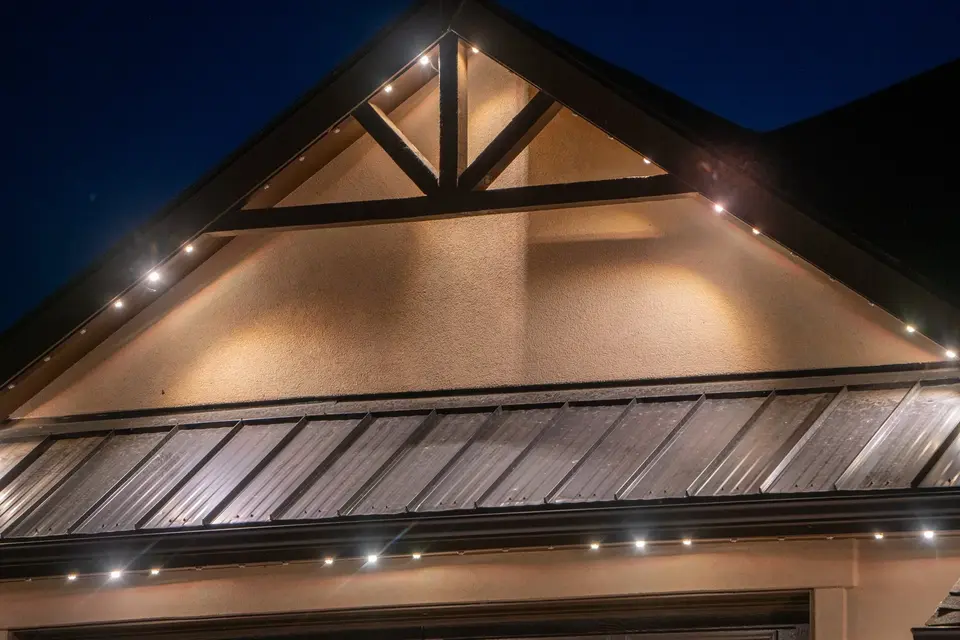
A close night photograph of a gable, with evenly spaced warm points of light running up both roof rakes and along the eave below, washing the gable face.
Every point is addressed on its own, so one gable can hold a single warm line tonight and any color you pick tomorrow.

What is one of these lights, exactly?

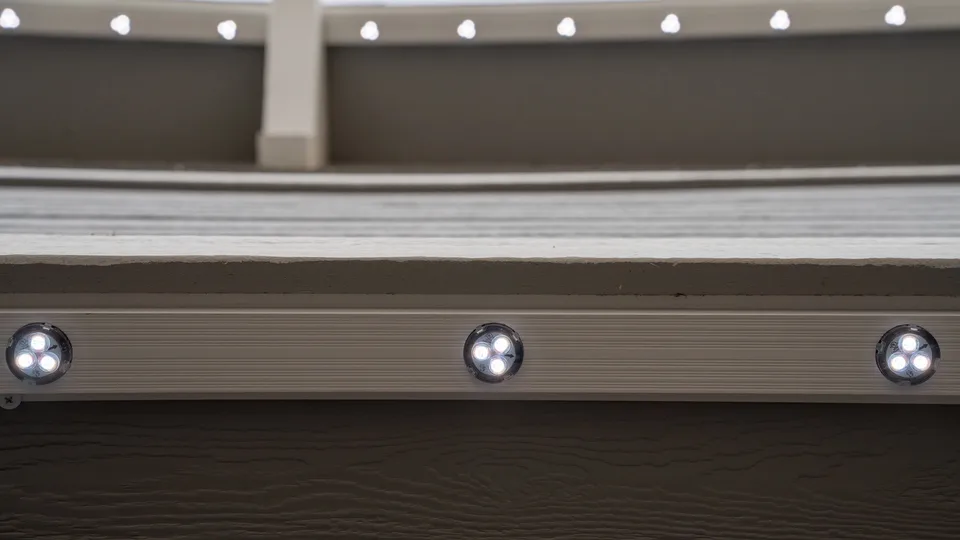
A body built for year round use, holding three LEDs, and each one carries four color diodes: red, green, blue and a dedicated white.

One light out of the system, close up: a round bezel over three LED dies on a molded body with a connector at each end.

The fourth diode is the one that matters on an ordinary night. A white mixed out of red, green and blue is an approximation of white; a dedicated white diode is white. That is why warm white on this system reads as lighting rather than as a color effect, and it is the difference you notice from the curb without knowing why.

They sit inside the channel facing out and down, so what reaches the street is the light and not the diode. The channel and the lights on a house is where that is photographed instead of described.

How many of them your house takes is a measurement, and the measurement is free: ask for an estimate.

How bright are they?

Each light is 72 lumens, among the brightest permanent lights made, and there are a great many of them: enough to draw the whole shape of the house from the street.

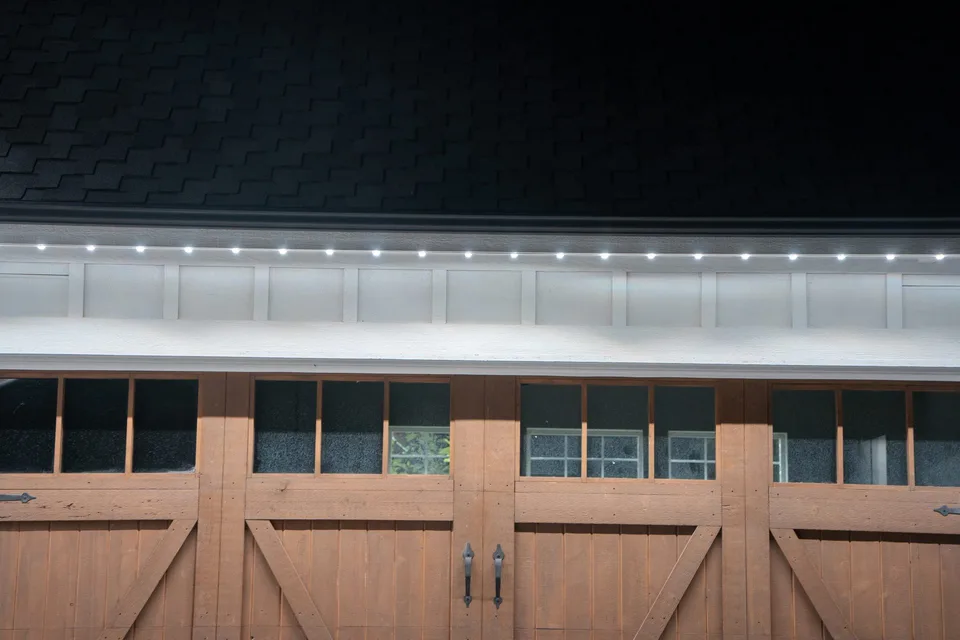
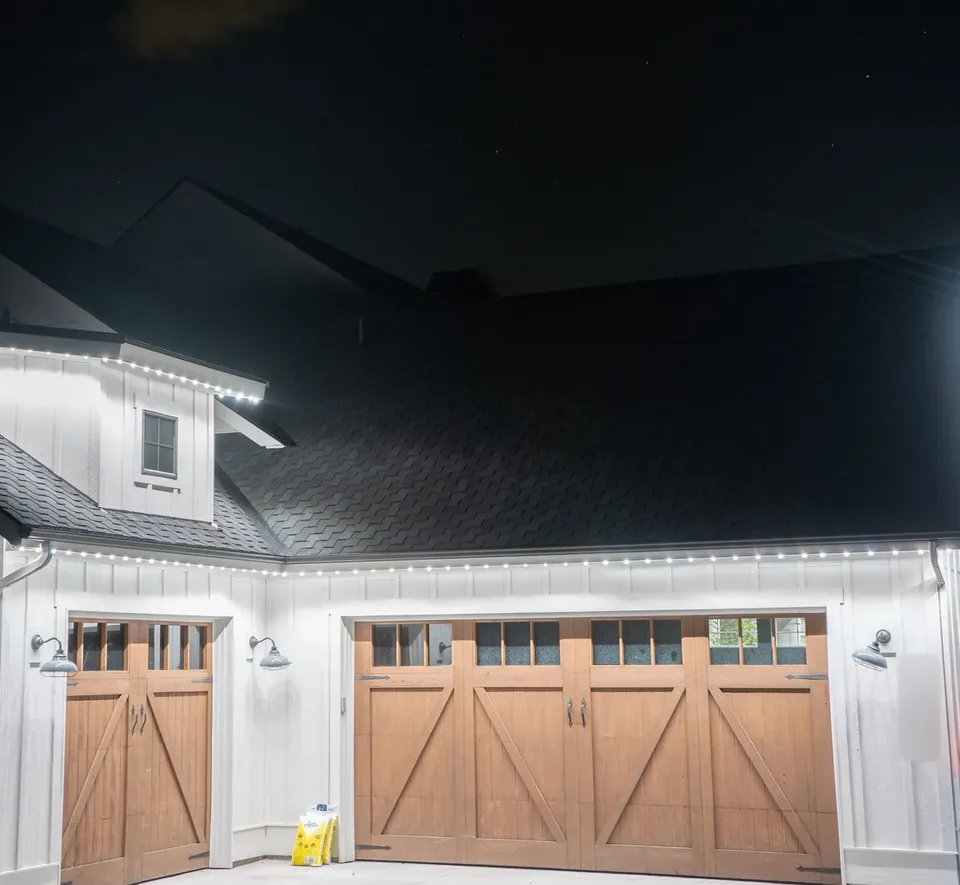
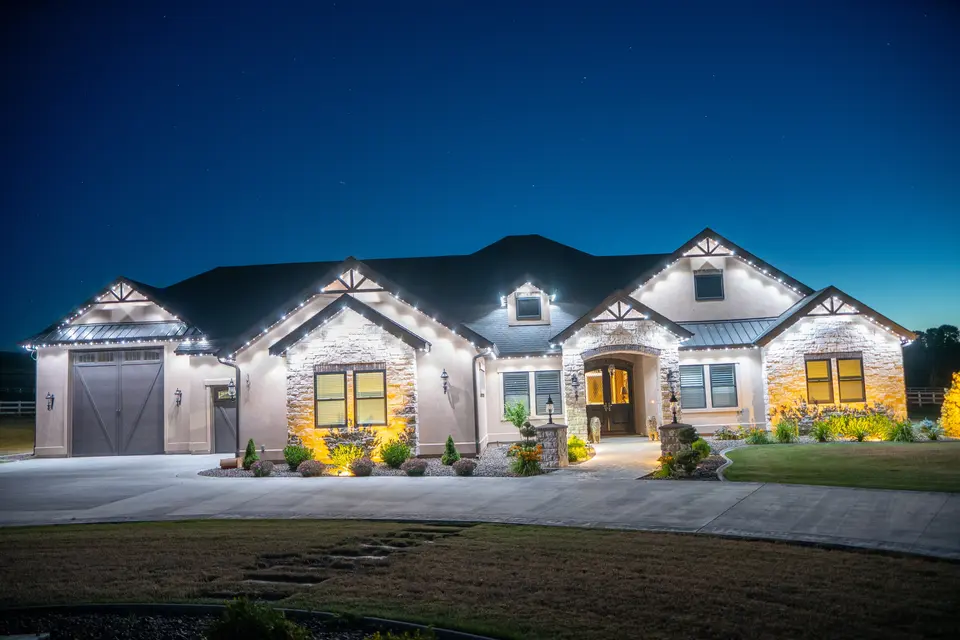
A cool white run along a garage eave above wood carriage doors, throwing a soft wash down the wall.

One of them on its own is a nightlight. A roofline of them, spaced along the eave and up both rakes, outlines the house in the dark and throws a soft wash down the wall underneath. It is not a floodlight and it is not trying to be one, which is exactly why it looks like architecture rather than like security lighting.

Brightness is adjustable, so treat 72 lumens as the ceiling rather than the level: most of the year it runs dimmed, which is also the assumption behind leaving them on all night.

Bright enough to draw the whole house from the end of the street, soft enough to live with every night. See it on your own roofline: get a free lighting estimate.

What is the channel made of and how is it fixed on?

Aluminum, in one of three profiles, color matched to your house.

Evenly spaced warm points along a rake board in overcast daylight, seated inside the channel.

Three profiles exist because a boxed eave, an open rafter tail and a steep gable rake are three different edges, and one shape of channel cannot follow all of them without the line wandering off the architecture. The right one gets chosen against your own roof edge, on site, before anything is ordered.

The dimension that matters is the edge of your own roof, and the profile is picked to follow it. The system page shows the channel, the corners and the returns, each in a photograph.

Show the installers the edge and they will match the profile: free estimate.

How many lights will my house need?

It comes off a measurement of your own roofline. For scale, an average system is about 250 lights.

A wide estate at night with warm amber light following every roof plane across the whole front.

The count follows the eaves, the rakes, the porch and anything else you want lit, which is why nobody can answer it off a photograph. Treat 250 as a yardstick rather than an estimate: a single-story ranch with one long eave and a two-story with four gables are not the same house and never come back with the same number.

The count is also most of the reason one house costs more than the next. What moves the number is laid out on the pricing page.

Your own count comes with the free estimate. Send the quote form and an installer will call you.

Where does the control box go?

Usually inside the garage, out of the weather, where the wifi is strong.

Cool white light above the wood carriage doors of a board and batten garage after dark.

In practice that is a wall in the garage near where the runs come in: out of the rain, out of the sun and out of the way. It is a small box, it is quiet, and once the schedule is set most owners forget which wall it is on.

If you want it somewhere else, say so at the walkthrough and that is where it goes, as long as the wifi reaches. The controller and what it is doing shows where it sits, and linking more than one of them covers the houses that need two.

The installers will pick the spot with you on the estimate visit.

Is it safe, and has any of it been tested?

Every component in the system is UL rated, and the testing was done by outside companies rather than in house.

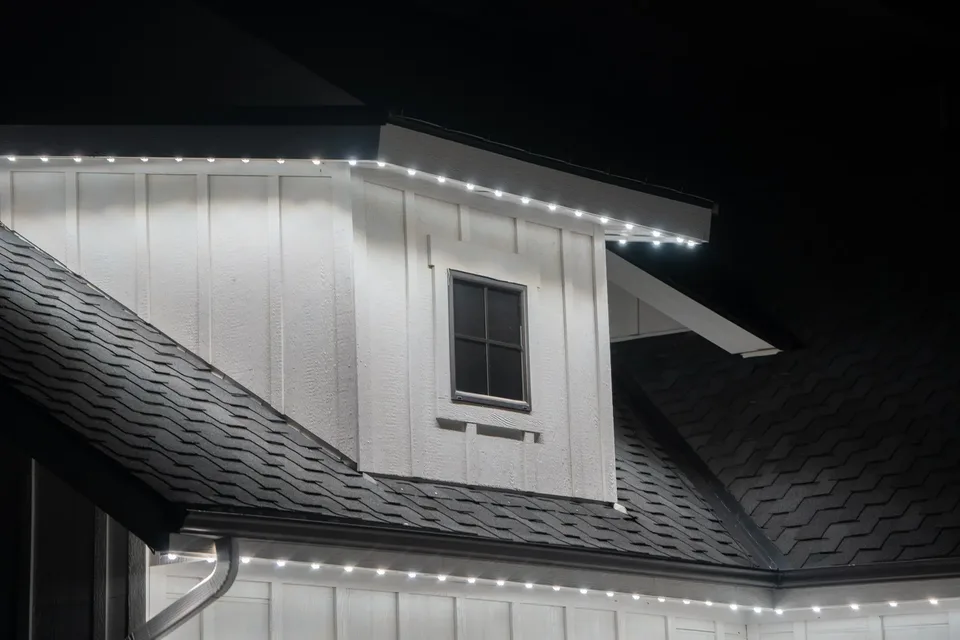
Cool white points along an eave and a gable return on a dark shingle roof, close in.

That is the product half.

The other half is ours and it is the half that actually protects your house: a wiring run, fixings into the fascia and the soffit rather than through the roof surface, and nothing bridging the gutter. What happens after the install is where the rest of that sits.

If safety is the thing you are weighing, ask our installers about it directly on the walkthrough: request a free estimate.

What happens to it in ice, heat and storms?

It stays outside permanently, which is the one thing a seasonal string of lights cannot do.

A farmhouse at dusk under a heavy sky, the roofline holding steady cool white.

The lights sit inside the channel, and the components are UL rated. Middle Tennessee gives it a hot wet summer, a handful of hard freezes, ice sitting on the north slope for a week at a time and the occasional high wind.

Nashville International Airport averages about 71 days a year with lows at or below freezing, and Winter Storm Fern brought an ice storm to the city in January 2026. The lights stay in the channel through every one of those freezes, with no winter takedown and no spring reinstall.

The plain version of weatherproof is that nothing comes down in the autumn and nothing goes into a box: it rides out every season right where it is. What is covered, and what we ask of you is the longer answer.

Your roofline has its own weather problems, north slopes included, so have it looked at in person.

Can it go somewhere other than the roofline?

It goes wherever there is an edge to follow. Tell us the part of the house you are picturing.

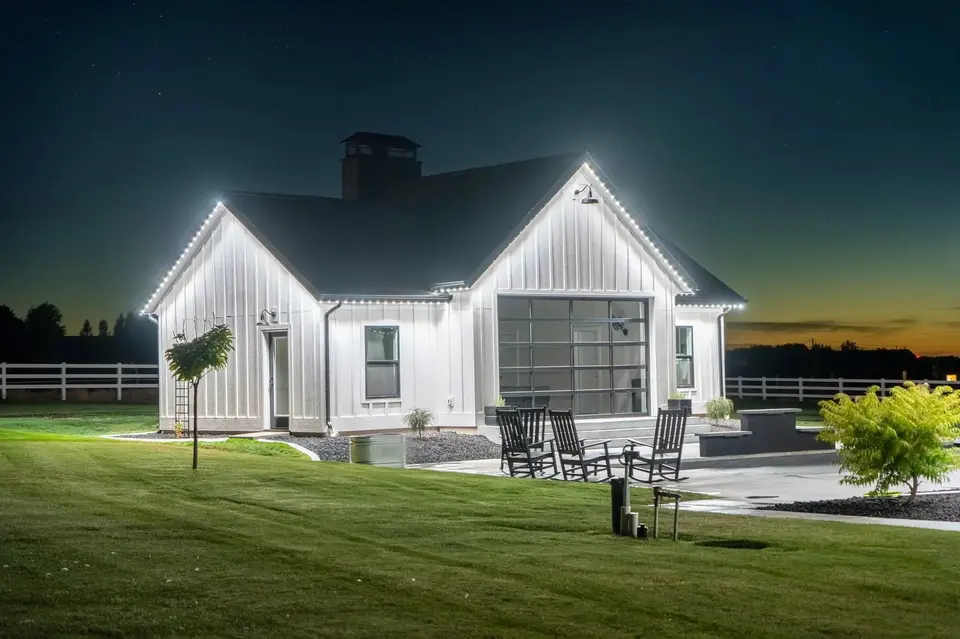
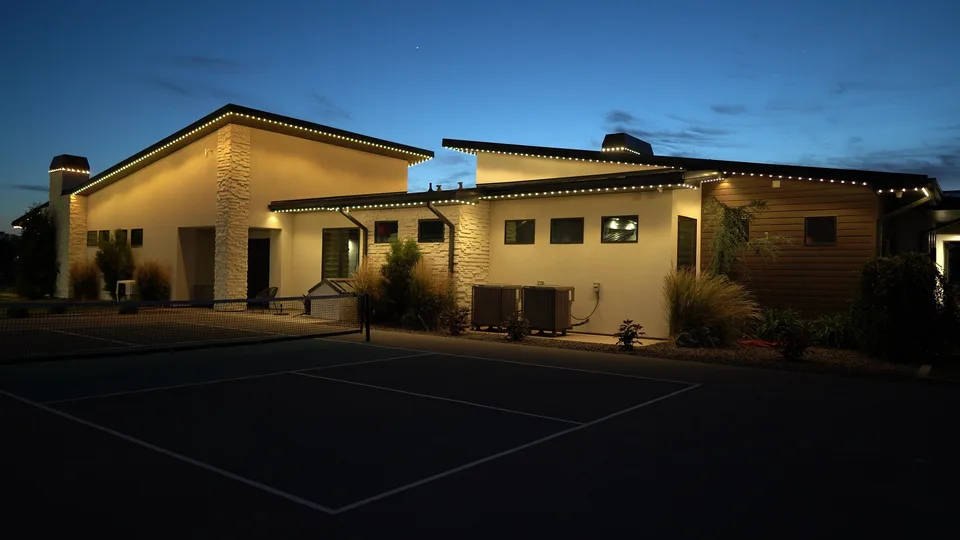
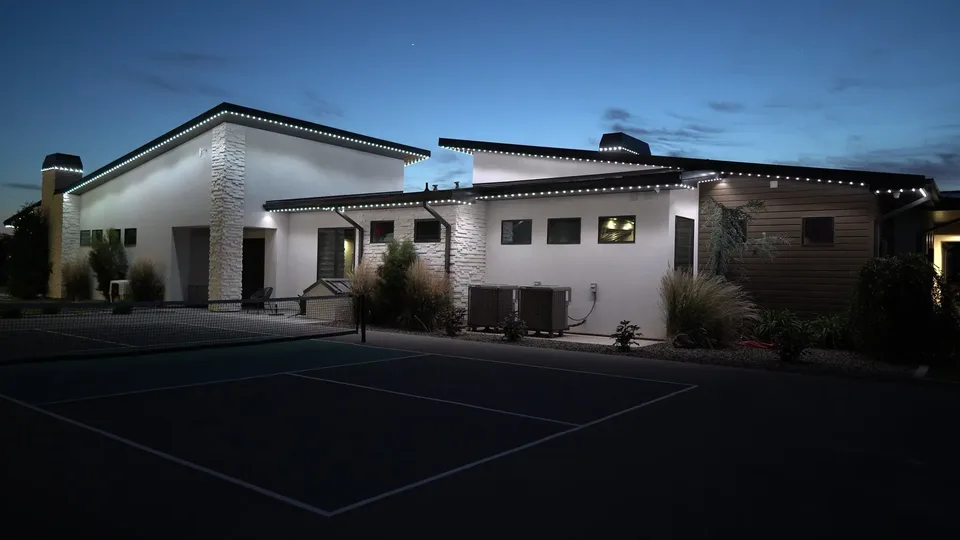
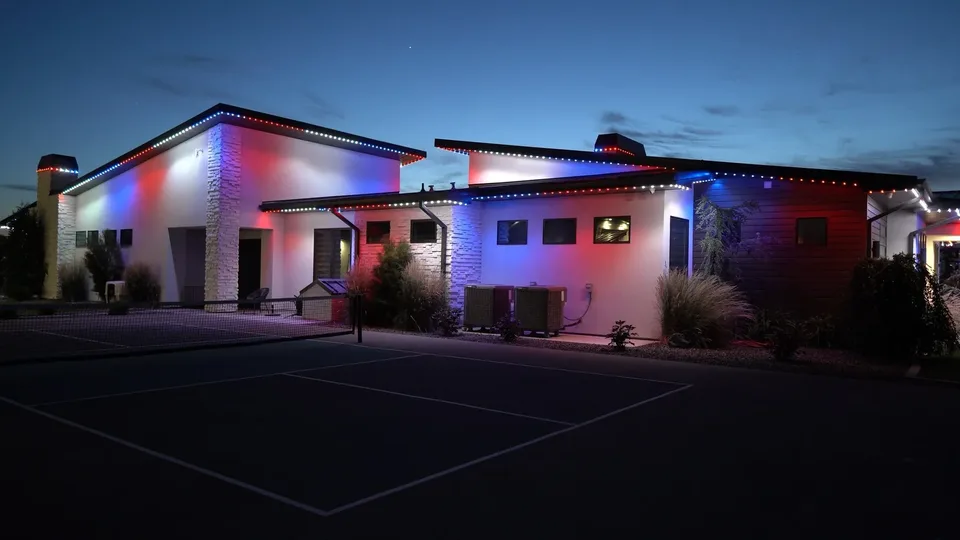
A modern house seen across a dark sport court at dusk, warm light along the eaves.

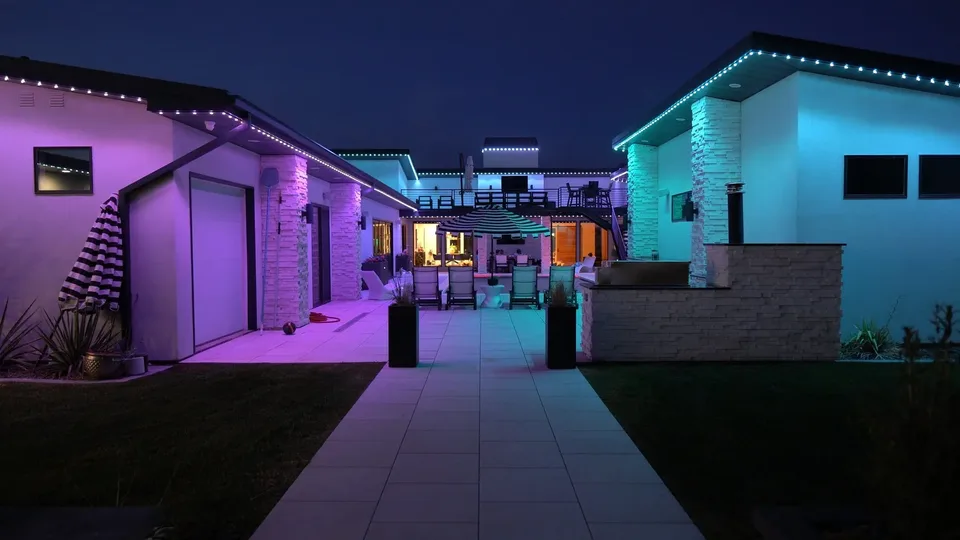
The roofline is the obvious run because it draws the shape of the house, but the same channel follows a covered patio ceiling, a column, a soffit, a pergola or an outbuilding just as well. Under a patio ceiling in particular it stops reading as a roofline at all and turns into lighting for a room with no walls, on a dimmer, every night of the year.

Each of those is priced off the structure itself, so it gets looked at before it is quoted. The system on a house is the closest thing to a preview. Lighting the grounds rather than an edge is a different job, and roofline vs landscape lighting compares what each one lights.

Describe the spot when you ask for a quote and the installers will tell you whether it works there.

The patio, the pergola, the outbuilding: tell us what you want lit.

Chapter 04

Controlling it

One app, one schedule, no monthly fee. After the first couple of weeks most owners open it about as often as they open the thermostat.

Built into the app
256presets in the app before you save one of your own
8zones per controller, each able to run its own scene

Both come with the app on day one, with no monthly fee.

How do I actually turn them on?

From an app on your phone. Once the schedule is set, mostly you do not.

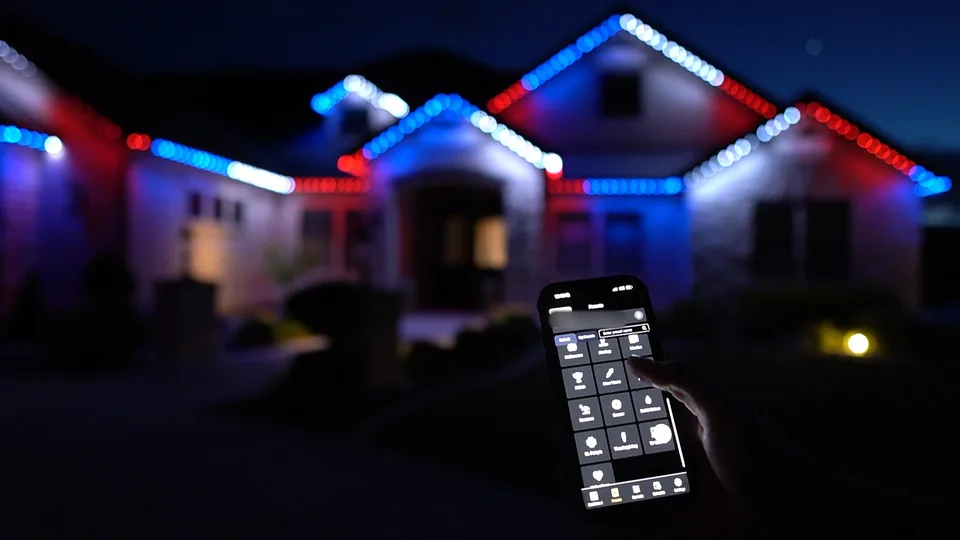
A phone held up running the lighting app, with the house behind it lit red, white and blue.

The programmable controller comes with every install, and the installers set it up with you before they leave, so the first schedule is already running on the day the channel goes on. The app is on iOS and Android and it takes about a minute to learn.

The reason the app matters less than it sounds is exactly that schedule: a house that comes on at sunset and goes off at a time you chose does not need anybody to open anything. The app and what it actually does walks through the screens.

The installers do the setup with you, in person, at no extra cost. It starts with one free estimate.

Will the app still be looked after in a few years?

Yes. A team of in house engineers built it and ships new features to it every week.

The same ordinary ranch after dark, now holding cool white instead of warm.

It matters more than it sounds, because anything that stays on a house is a bet on whoever keeps it working. This app is not a contract job that gets finished once and abandoned in three years: the engineers who built it are still updating it, and new features arrive every week.

What that means for you day to day is that features arrive on your phone without anybody coming back to your house. What the app actually does goes through the screens.

The first schedule gets set up with you on install day, which starts here: free estimate.

Is there a monthly fee or a subscription?

No. No monthly app fee, no annual app fee, no subscription of any kind.

A long elevation in cool white against a bright evening sky, the roofline drawn point by point.

You buy the system and the install once, and the app that drives it comes with it. There is nothing on our side either: no service plan to sign, no activation, nothing that stops working if you do not pay next month.

Worth checking on anything you are comparing this against, because a system that bills you monthly for the ability to turn your own lights on is a different purchase. The only running cost here is what it adds to the power bill, which is very little. What a system costs is the one-time side of it.

One price, once, for your roofline: get the free estimate.

Can I control it when I am not home?

Yes. It is cloud based, so anywhere your phone has service.

A modest ranch in full dark with cool white light along the eave and both gables.

The practical version is turning the house on from the interstate on the way back from a weekend, or turning it off from a hotel because you left it running. A lit house is also a house that does not look empty, which is worth something on the week you are away.

The schedule keeps running whether your phone is in the house or not, which is the part that matters when you are gone for two weeks. The app, from the outside in.

It starts with a measurement of your roofline: ask for the estimate.

Does it work with Alexa or Google?

Alexa, Google Assistant, Siri and Control4.

A cool white roofline above warm landscape lighting in the beds below it.

If the rest of your house already answers to one of those, the roofline can answer to it too, which for most people means asking out loud instead of finding a phone. It joins what you already have rather than adding another app you have to remember.

None of it is required. The controller and the schedule are the whole mechanism and the voice platforms sit on top of it. What the app does on its own.

Tell us what your house already runs when you ask for a free estimate.

Can different parts of the house do different things?

Up to 8 zones on one controller, each running its own scene at the same time.

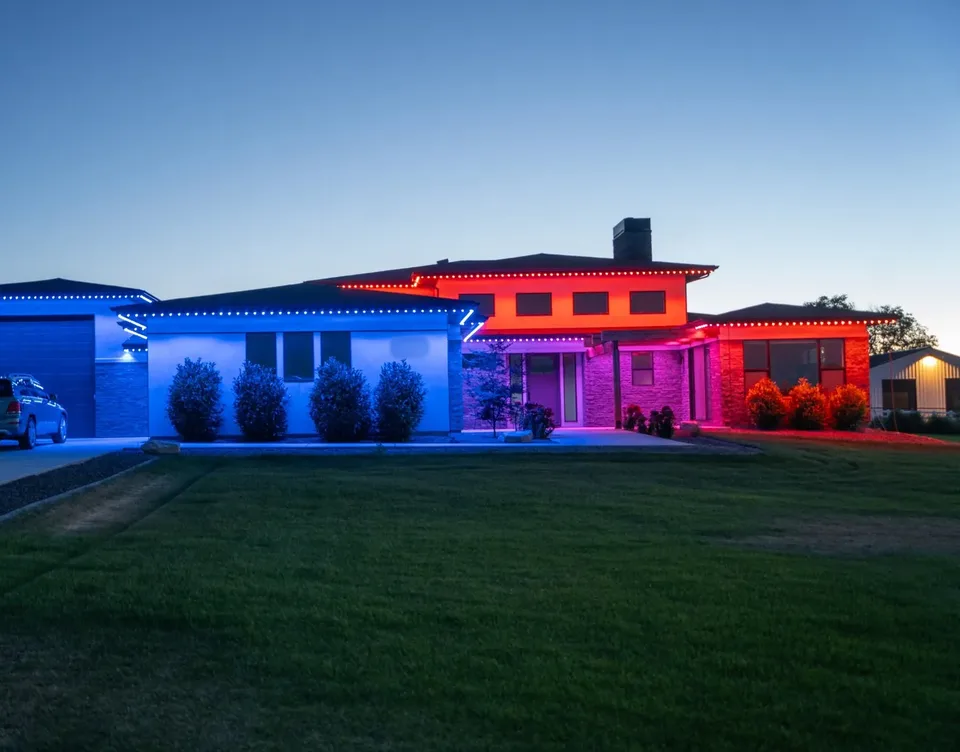
Blue, red and magenta running at the same time on three separate zones of one elevation.

In practice that means the porch holds warm white while the gables run color, or the back of the house is off while the front is on, or one wing does the holiday while the rest of the house stays exactly as you like it. Where the zones fall is decided when the system is laid out, which is one more reason the walkthrough is worth your time.

It is also the setting that keeps the December version from taking over the whole house. The same zones in color, and the app that switches them.

Zoning your house well is a design decision the installers make with you on site: book the free estimate.

What if the house needs more than one controller?

Up to 4 controllers on one account, linked and behaving as one system.

Magenta, teal and green held at once on three separate roof planes of one house.

A long house, a detached garage or an outbuilding can need a second box. The point of linking them is that the whole property still behaves as one system on one login rather than as two apps you switch between while standing in the driveway.

Whether your house needs one or two is a measurement rather than a preference, and it falls out of the walkthrough. Where the box itself goes covers the hardware.

Detached garage, guest house, barn: name them when you ask for the estimate and they get measured too. A big house with several wings is worked through in permanent lighting for large and estate homes.

Can I set it and forget it?

That is where most owners end up: a sunset trigger, a schedule, and nothing to do at night.

A ranch lit warm white under a purple and orange ridge sunset, the roofline already on.

Recurring schedules, sunrise and sunset timers, and scheduling in advance are all in the app, so the lights never wait on you to remember them. Set it once in the first week and the house lights itself at dusk for the rest of the year.

Scheduling ahead is also how the holidays happen without you, which is the same mechanism pointed at a date: does it set itself for the holidays. The schedule screens show what that looks like.
The first schedule is set with you before our installers leave.
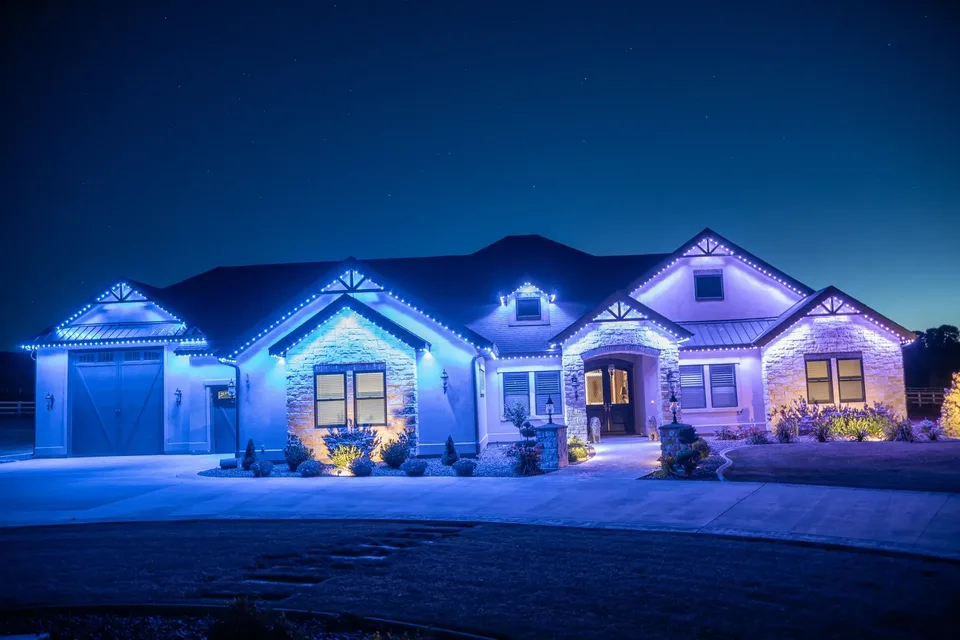
Set it once and the house lights itself.
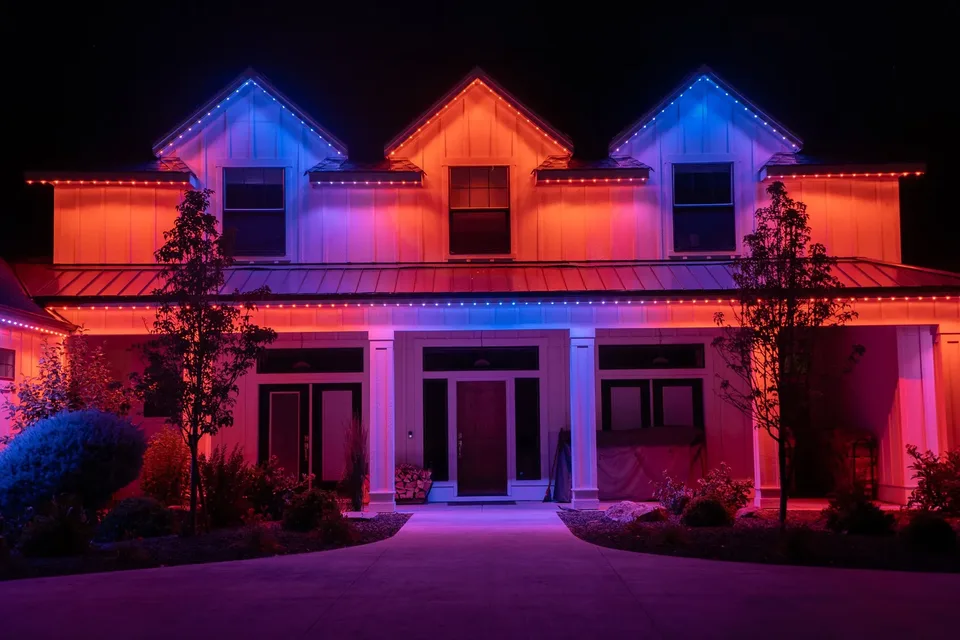
Can it come on when I get home?

Yes. The app can answer your location, so the house is lit as you turn onto the street.

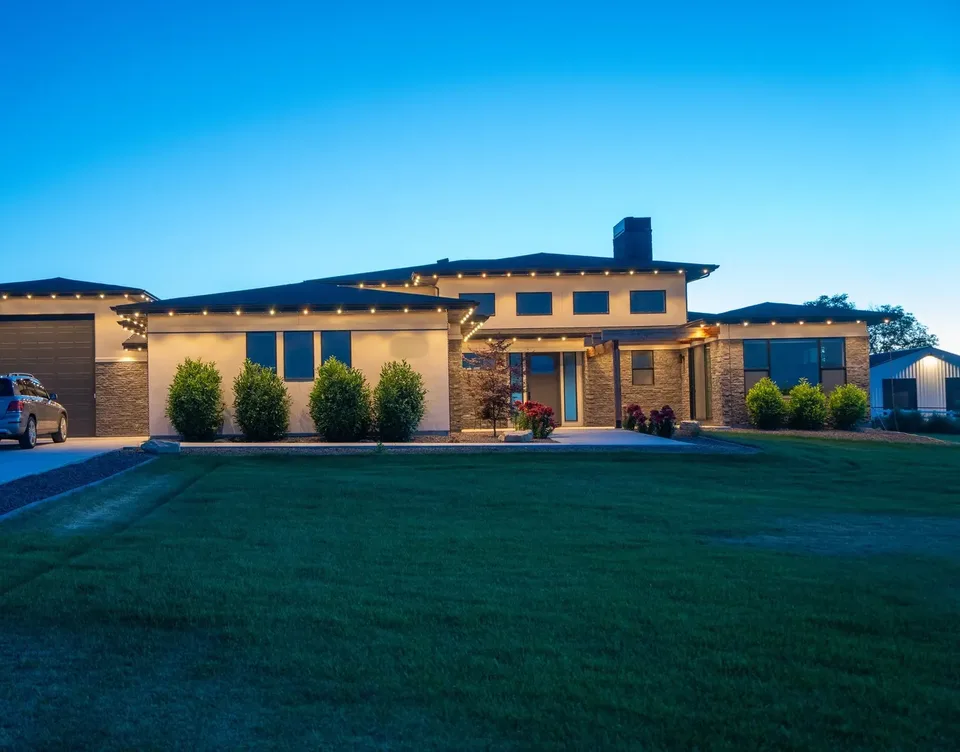
A long prairie-style house, two stories at its center, against a bright evening sky, warm white light running the full eave.

Pointed at your own address it means the house is already on when you arrive rather than waiting for a time you chose back in June. It is included in the app and there is nothing extra to buy to use it.

It sits on top of the schedule instead of replacing it, so the house still lights itself on the nights nobody is coming home at all: can I set it and forget it.

The system that does this is quoted off your roofline, once: ask for a free estimate.

Can I build my own look rather than pick one?

Yes. The app has a full custom section and you can save as many of your own scenes as you like.

One roofline run grading from cyan through green and yellow into magenta.

A color nobody named, at a brightness you chose, on the zones you picked, is something you build once and then tap forever. Most owners end up with four or five of their own and use the defaults for the rest of the year.

You can drive a version of it here before anybody quotes you anything: the presets, on a house you can change, and the colors themselves.

Then put it on your own roofline: free estimate.

Can I just tell it what I want?

Yes. Describe what you want, and its AI sets the lights to match.

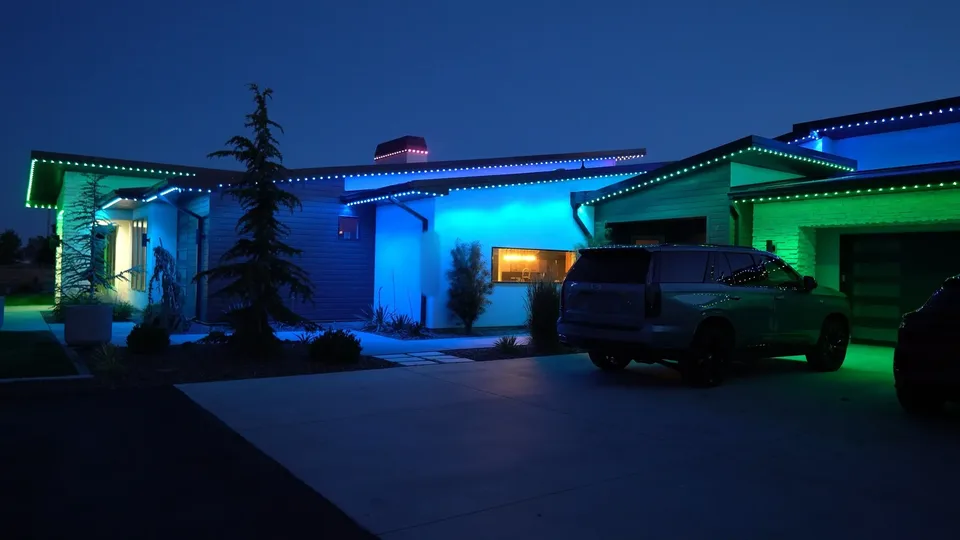
A driveway view of a house holding cyan, blue and green across separate roof planes.

Ask for the lights to be red and it happens, ask for a holiday display and its AI creates it instead of you assembling it by hand, ask it to shut off in an hour. It is part of the free app rather than a paid add-on, which is the same answer as is there a monthly fee.

It is another way into the same controls rather than a second system: the color wheel, the saved scenes and the zones are all still where they were. What the app does, screen by screen.

None of it runs until there is a system on the house, and that starts with one free estimate.

Chapter 05

Color and holidays

Color is available every night of the year and obligatory on none of them. Most houses live on warm white and spend three weeks a year being spectacular.

One run, every color it makes
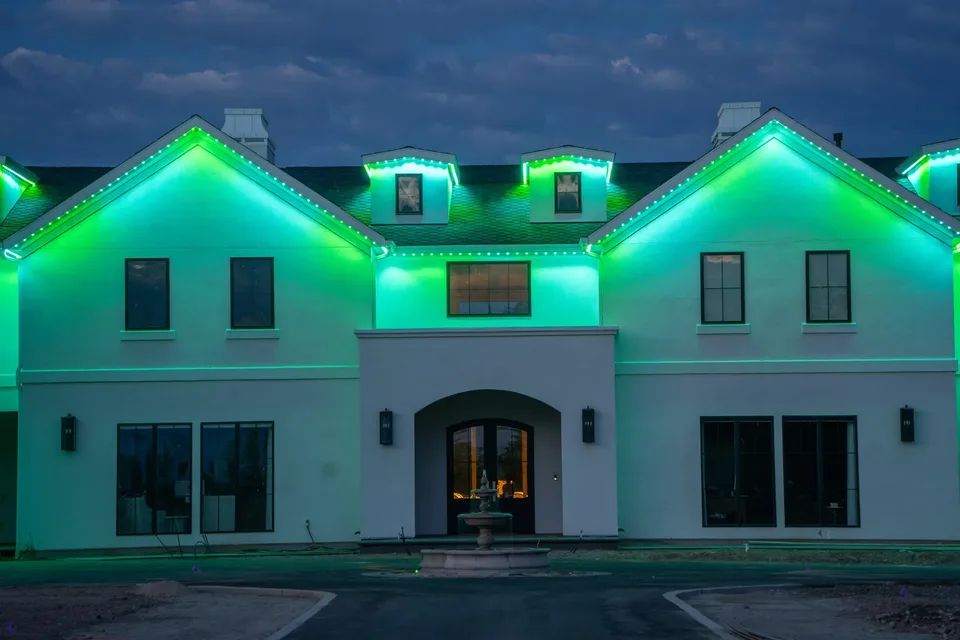
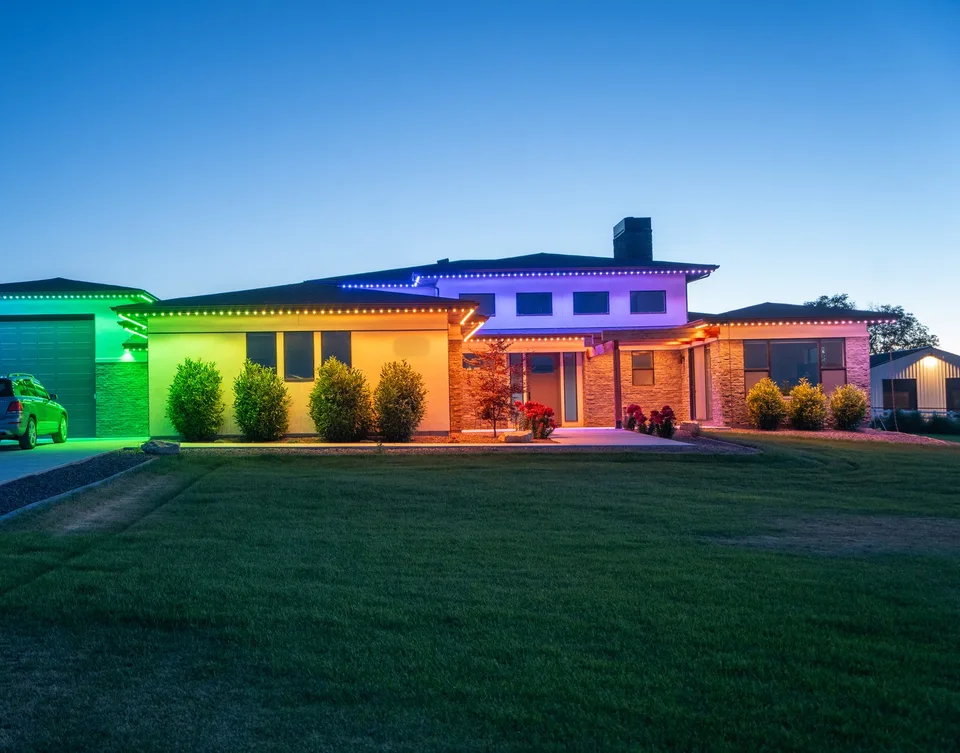
A long modern house at dusk with its roofline running through green, gold, orange, pink and violet from one end to the other.
One run of lights, every color at once, and back to warm white with a tap.

Do I have to use the colors?

No. Warm white every night is a fine way to own this, and so is color every night.

A full blue wash across a roofline with the warm entry light glowing through underneath it.

Some houses sit on warm white, dimmed, doing the job a very expensive set of soffit lights would do. Others run a color they simply like, or a low wash that gives the roofline its shape back and nothing more. The programmable controller comes with the install and our installers set it up for you, so whichever of those you pick is the one it holds, and changing your mind costs you a minute on your phone.

You can drive the palettes yourself on the presets page and watch what each one does to a roofline before anybody quotes you anything, and the colors on real rooflines is the photographed version of the same thing.

Then see it on yours: get a free estimate.

Does it set itself for the holidays?

Yes, on the date you pick, without you being home.

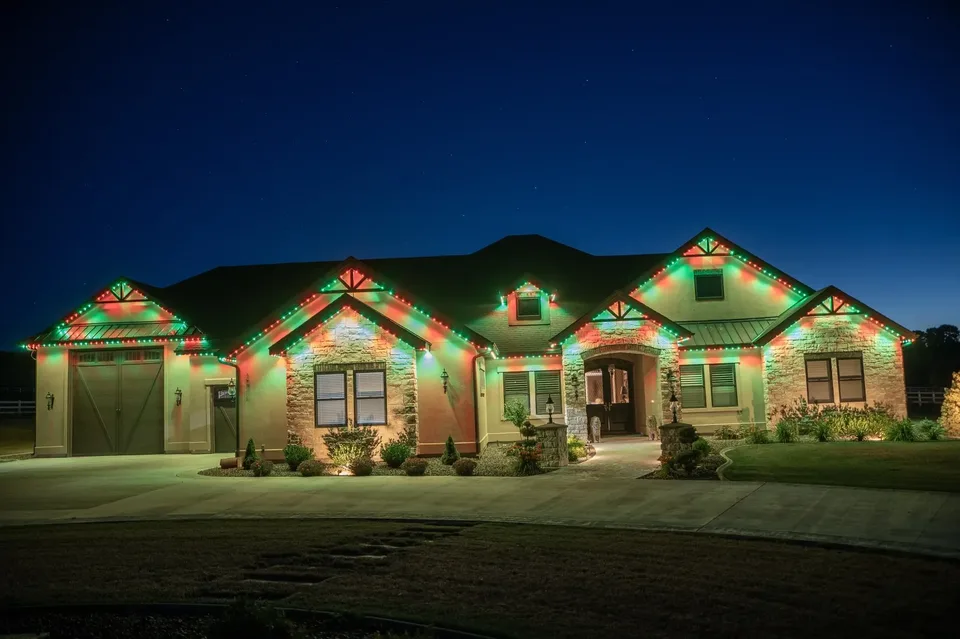
A stone ranch at night with red and green alternating along every gable and eave.

The controller handles it. It sets its own colors for the holidays, and it is completely programmable if you would rather drive it yourself, zone by zone. Pick the dates once and every holiday on the calendar arrives on the roofline without anybody touching a ladder.

For the December version of this question there is a whole page: permanent Christmas lights in Nashville. The mechanism underneath it is the schedule in the app.

The reason to choose Permanent Lighting Solutions is our installers, and that conversation starts with a free estimate.

How many colors is it really?

Over 16,000,000, which in practice means any color you can point at on a wheel.

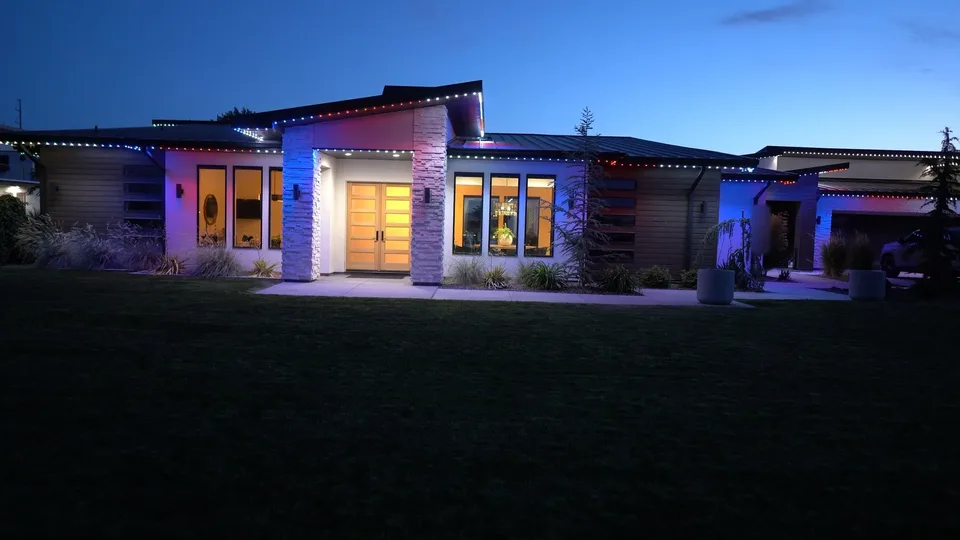
A modern farmhouse with orange on its middle gable and blue and violet on the two outer gables, the walls washed red and pink.

A number that size stops being a number and becomes a fact about the hardware: each light carries red, green, blue and white diodes and the app mixes them, so you are not choosing from a list of named colors, you are choosing a point.

Which is both less and more useful than it sounds. Nobody needs sixteen million. What you need is the five or six you actually want, and a white that looks right on your brick, and that is a far shorter conversation. The colors on a real roofline is that conversation in photographs.

The installers will have it on your driveway, in front of your brick: book the free estimate.

How many presets come with it?

256 by default, plus as many of your own as you care to save.

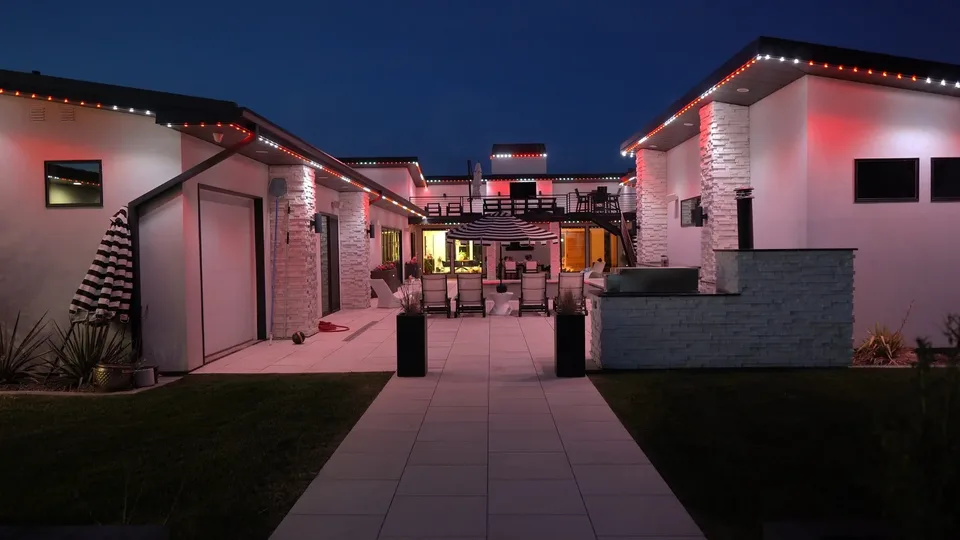
A white courtyard house at night, red and white points along its roof edges and a red wash across the walls, a pale tile path running back to a seating area.

The defaults are what you use in the first month while you work out what you like on your own house. The saved ones are what you use for the years after that, and they take one tap each.

You can play with the idea before you own it on the presets page, and the app that saves them is where they live once it is on the house.

Getting them onto your house takes one visit: ask for the estimate.

Which holidays can it do?

Every one you already decorate for, and several you do not, because adding one costs a tap.

Red, white and blue alternating along the roofline of a modern ranch at early dusk.

Christmas is the one people buy it for. Halloween, Thanksgiving, Hanukkah, New Year's, Valentine's, St Patrick's, Easter and the Fourth of July are the same hardware on a different setting, and the reason owners end up using all of them is that there is no ladder, no box in the attic and no separate cost per holiday.

The December version has a page of its own: permanent Christmas lights in Nashville. Any of the others can set themselves on the date you pick, which is the scheduling answer.

Next holiday on the calendar is the one to aim at: get your free estimate.

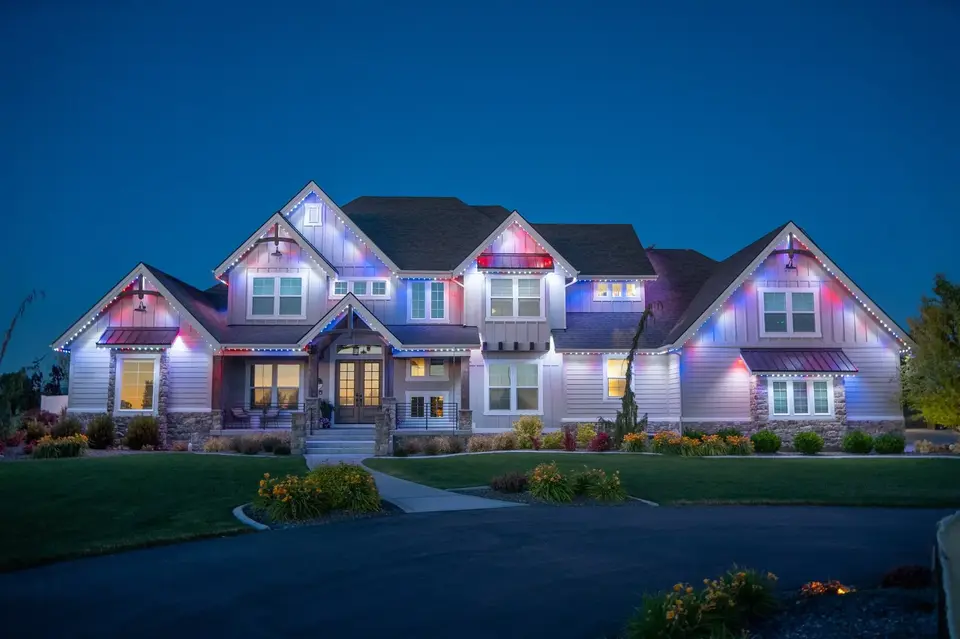
A large two story craftsman house at dusk with red, white and blue light running along every gable and eave.

The Fourth of July, on the roofline, and nobody climbed a thing.

Should I pick warm white or cool white?

You do not pick. Both are in the same system and you switch between them.

Five gables of a brick and stone house at blue hour, each one outlined in warm white.

Warm white reads like lamplight and flatters brick, stone and anything with a warm trim. Cool white reads more like moonlight and keeps a white or gray house crisp instead of yellow. They are two settings on one piece of hardware, so in practice you will live on one and reach for the other on a particular kind of night.

This is the one question where a photograph beats a paragraph, so the same house in warm and in cool carries the matched pair.

Your brick decides it, and one of our installers will stand in front of it with you: free estimate.

Chapter 06

Getting it on the house

What goes on the house, and how soon it is lit. Read the full installation sequence.

From yes to lit
8-10hours for an average install
1-2weeks from deposit to channel on the house, our goal

Rain, ice, wind or a full November schedule are what move the weeks, so the earlier you ask, the better.

Can I install permanent lights myself?

Kits exist. What they leave out is the part you are really paying for.

A person balanced on an extension ladder in winter, working along the edge of a roof.

Stick-on strips and channel kits are sold direct, and every one of them hands you the hard part: a day at height on your own roof edge, drilling into your fascia, sealing each fixing and wiring the run back to a controller. A DIY kit against a professional install is compared point by point on its own page.

With us, the color match, the mitered corners and the wiring are somebody else's job, and somebody answers for them afterwards. The installers put it up, and it is backed by the manufacturer's 5-year product warranty and our installers' workmanship warranty. A kit is backed by whatever its own box says.

Get the professional number before you commit to the weekend: the estimate is free and it tells you what you are actually choosing between.

What actually gets mounted on my house?

An aluminum channel along the eave, lights seated inside it, and a control unit indoors.

A finished single story house after dark, the channel holding an even run of warm white along the eaves and gables.

The visible part is a slim aluminum channel fixed along the eave or fascia line with the LEDs seated inside it. The rest is a run back to a control unit that lives inside the house, out of the weather.

It does not hang from the gutter and nothing is strung between trees. There is no seasonal version of the hardware either: what is lit in December is the same channel that was there in June, doing something quieter. There is a whole page of it, close up and in daylight: what gets installed on your house.

What it looks like on your eaves is a five minute walk around the house with one of our installers: ask for a free estimate.

When does the install happen after I say yes?

Usually 1 to 2 weeks after the deposit. Weather and the schedule move it.

A white farmhouse with a covered porch, cool white light following the eave and the porch roof.

The installers aim to have the channel on the house inside 1 to 2 weeks of the deposit. Read that as a goal rather than a date: rain, lightning, ice on the roof, high winds, or any day the roofline is not safe to work on pushes it, and so does a full schedule in November when half of Nashville wants lights up at once.

Which is the argument for not waiting until November. A quote in September gets ahead of that schedule; the same quote in the last week of November is a queue.

You get a real date once the roofline has been measured. Pick Call and leave a number and one of our installers calls you back as soon as possible; pick text or email and the reply comes that way instead. Send us the house and that is the first thing that happens.

The sooner you ask, the sooner it is lit.

Does it damage my roof or gutters?

No. No fastener goes through the gutter or the roof.

The eave from below in late sun, the channel sitting under the roof edge and clear of the gutter.

The channel belongs under the soffit or on the fascia. Gutters and the roof edge are what keep water off the building. The track is a low-profile aluminum channel mounted along the fascia or soffit: our installers put it exactly there, and no fastener goes through the gutter or through the roof surface.

Roof damage from lighting is a workmanship problem: drilling into the shingles or roof deck, the wrong fasteners, sealant skipped where it is needed, and hardware over-tightened until vinyl soffit cracks. A fastener that stays in the fascia, soffit or trim sits outside the roof system, not in the shingles.

If that is the question you actually came with, ask it again with one of our installers standing under your eave. It is the fastest way to tell a careful installer from a fast one. What is covered afterwards answers the rest of it.

Have the installers look at your roof edge and say exactly where it would sit: book a free estimate.

How long does the install take once you are here?

Most of a day for an average roofline. Your own number comes off the walkthrough.

Warm points running the length of a long shed eave at blue hour, finished and lit.

An average install is 8 to 10 hours, and what moves it is the size of the job: one long eave is not four gables, two porches and a detached garage.

How soon that day comes is when the install happens after you say yes, a question of its own.

The real number for your house comes out of a look at your roofline, and that look is free.

Chapter 07

What it costs

The fair first question. Your number comes off your own roofline, and this chapter is what moves it.

Where a system starts

The pricing page shows where a system starts, and what moves it on a real house. Your own number comes off a free measurement of your roofline.

See How Pricing Works

Your roofline decides the rest of it, which is what a quote is for.

How much does permanent roofline lighting cost in Nashville?

It depends on your roofline, and measuring yours is free. The starting figure is on the pricing page.

A large house at twilight with the whole roofline lit cool white against a deep blue sky.

What a permanent lighting system costs comes down to your house: how much roofline you light, how high it sits, and how easy it is to reach. Our pricing page walks through what moves the number. There is no published per-foot rate; each quote is measured on the house.

Your own number is free. Send the quote form and an installer will call you; the price for your roofline follows.

Why do permanent Christmas lights cost more on one house than the next?

The price varies mostly by length, then by the bulb system. The controller comes with every install.

Warm light raking across stone gables, each plane of the roof picked out separately.

Length first, because it is the biggest input by a distance. A single-story ranch with one long eave and a two-story with dormers, gables and a wrapped porch are different amounts of channel and different amounts of time off the ground. That is why every foot of it gets measured before anybody says a number.

Then the bulb system, where the tiers differ in how densely the lights sit, how bright they run and how finely each point can be addressed. The programmable controller is not one of those variables: it comes with every system, set up for you by our installers.

Which of those levers matters on your house is visible from the driveway and invisible from here. Get the free estimate and the installers will show you where your number comes from.

Your house, your number, measured for free.

What does a quote actually include?

The lighting system, standard materials, the controller and a full install. One price.

A two car garage and entry tower lit warm white along every edge after dark.

A quote covers the lighting system itself, the standard mounting materials that go with it, the controller and power equipment that run it, and the installation: setup, testing, and a walkthrough with you once it is on the house. It is priced as one complete project rather than a stack of line items you find out about later.

A few things can add cost on top of that base: a lift if the roofline needs one, difficult access, electrical that is not straightforward, or a complex install with a lot of angles and returns. Any of that gets called out before the work starts, not after.

You will see the whole scope in writing before anybody is on your roof. Start with the free estimate.

Do you offer financing?

Available. Ask for it in the same request as your estimate.

Warm white under the eaves of a stone turret and estate front at blue hour.

Yes. Financing is available for permanent lighting installs. Mention it when you request your estimate, and the details come with your quote.

Request a free estimate and tick the financing box on the form.

What will it add to my power bill?

Very little. A whole system draws about the same as five light bulbs.

A modern ranch beside a sport court holding cool white along the roofline.

Two numbers make that checkable rather than reassuring: each light is 0.96 W, and an average system is about 250 lights. Multiply them and an average system lands around 240 watts at full output, which is where the five-bulb comparison comes from. We are showing you the arithmetic rather than the conclusion so you can check it yourself.

It draws less than that in practice, because most of the year it runs dimmed and on a schedule rather than at full output all night. Add the app, which costs nothing a month, and you have the whole running cost: no monthly fee and no subscription. To work it out for your own house, use the electricity-use calculator for a Nashville roofline.

The one-time number is the one worth asking for: free estimate.

Want the number for your house?

The number comes from your roofline, so it comes from a quote. It is free. Choose Call on the form and one of our installers phones you, usually within 15 minutes.

Get A Free Lighting Estimate
A white stucco house with a fountain courtyard, its roofline lit warm white after dark.
Chapter 08

Lifespan, care and what is covered

What happens after the install, in the order people ask about it: how long it lasts, what stands behind it, and the one thing it ever asks of you.

How long it lasts
10-20years at 6-12 hours a day
50,000rated hours on the brightest setting

Put up once, and lit for years of ordinary evenings.

How many years do permanent lights last?

At 6 to 12 hours a day, the system works out to about 10 to 20 years.

A gable close up at night, the individual points reading as separate lights up both rakes.

That is our figure, at an evening's worth of use. The diodes themselves are rated for roughly 50,000 hours on the brightest setting.

Put the two together and this is hardware you buy once in the time most people own a house. The rated life and what stands behind it is the page that takes it further.

A roofline that lights itself every December starts with one measurement: ask for a free estimate.

Can I leave them on all night, every night?

Yes. Our 10 to 20 year range is based on evening use, so lights left on all night will use up those years sooner.

White points along the low-pitched hip roofs of a modern stone and stucco house at dusk.

Our own 10-20 year range assumes 6-12 hours a day, which is about an evening's worth. Leave a run on around the clock and you are asking it to work two to four times as many hours a year as that range was worked out on, and the years come off the far end.

Run them through the evening and switch them off overnight and the range holds. The programmable controller makes that a non-decision: set the schedule once and it keeps it, which is the schedule side of the app.

That schedule is set with you on install day: book the free estimate.

What is covered if something goes wrong?

Backed by the manufacturer's 5-year product warranty and our installers' workmanship warranty.

A single light out of the run, close enough to see the bezel, the three dies and the body.

Whether it is a light or the install, the first move is the same: tell the installers what you are seeing and they take it from there.

The rest of it, from care to what happens when a light goes out, is on what is covered, in full.

Ask us for the detail in writing with your estimate.

Something looks off? One message, and the installers take it from there.

What if one light stops working?

An installer comes out to fix it. One point out is not a run out.

A run of evenly spaced points along a rake board in daylight, each one seated in the channel.

You tell us what you are seeing and roughly where it is, and that is the whole of what we ask of you.

If you picked Call and left a number, one of our installers calls you back as soon as possible; pick text or email and the reply comes that way instead. The visit gets booked from there.

Use the same quote form for a repair as for a first quote.

Do I ever have to clean them?

Rinse them when you rinse the gutters. That is the whole maintenance schedule.

The channel under an eave seen from the ground in late sun, within reach of a garden hose.

Dust, pollen and spider webs collect on anything mounted under an eave, and a lens with a season of pollen on it throws slightly less light than a clean one. A hose from the ground, on the day you were already doing the gutters, is the entire job. No ladder, nothing comes off the house, nothing needs to be opened.

What you never do is take it down, store it, untangle it or put it back up in November, which for some owners is worth more than the lighting is. The ladder question is where that started.

That is the whole of the ongoing work. The rest is one visit: get your free estimate.

Chapter 09

Working with us

The practical end of it: where we work, and how fast you hear back when you send something in.

Which areas do you cover?

Nashville, TN & the surrounding Middle Tennessee area.

A modern single story house seen across a sport court at dusk, the roofline in red, white and blue.

If your house is anywhere in that area, we want to see it. A house out on the edge is a conversation, not a no.

Each town writes its own outdoor lighting rules, and the exterior lighting rules by town are collected on one page.

Not sure whether yours is inside it? Send us the address and ask. Pick Call and leave a number and one of our installers calls you back as soon as possible.

How quickly will I hear back?

Pick Call and leave a number, and one of our installers calls, usually within 15 minutes.

The corner of a stone and stucco house at sunset, white points along the gables with the odd red one between them, and red washing the stone and the gable trusses.

There is nothing to sit through: what you send goes to a person. Pick Call and leave a number, and one of our installers calls you back as soon as possible, usually within 15 minutes; pick text and the reply comes by text, pick email and it comes by email.

When the reply comes it is about your roofline, which is the only way the rest of this gets answered: ask for your free estimate.

Still deciding

Ask us the one that is not on this page.

Anything left over is almost certainly about your roofline in particular, and that is the one thing a web page cannot answer. Tell us about the house, and the installers will tell you what it takes to light it.

Licensed, insured and certified installers.

A wide house after dark, every roof plane and gable traced in one unbroken line of light.
A single story house at sunset with its roofline lit warm, under a purple and orange sky.