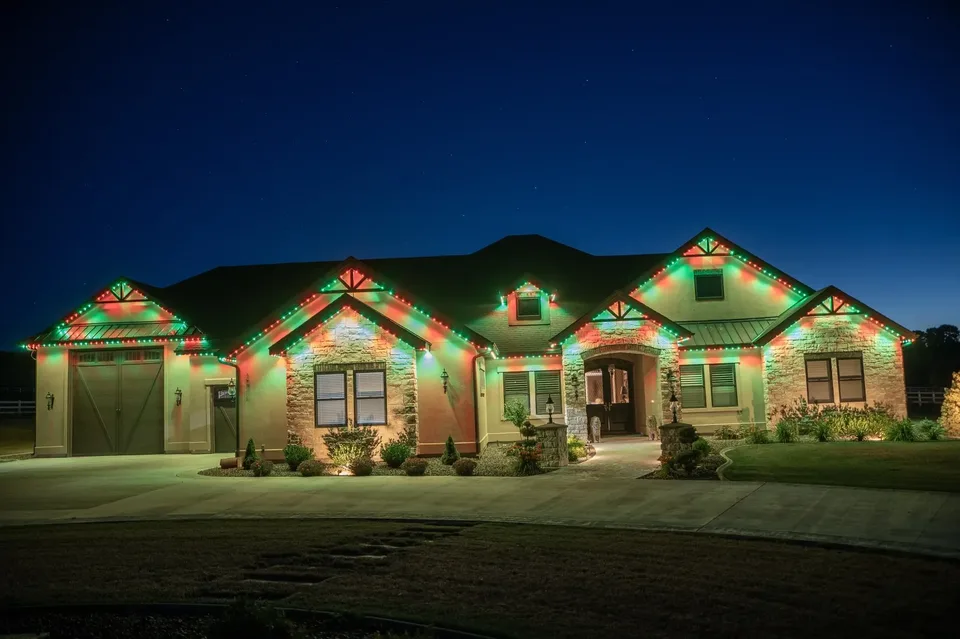
The roofline is the frame of a Christmas display, because it is the one outline every neighbor sees from the street. Pick the look by the shape of your house: a long eave wants a steady rhythm, and a house full of gables wants the peaks and the eaves to answer each other.
Everything below is red and green, and every look is a setting on a permanent system, not a second set of lights. The roofline runs warm white the rest of the year and turns red and green when you tell it to. The effects named here (solid, alternate, chase, wave, flow, twinkle and breathe) are the ones in the presets picker, so you can try each on a model house before you decide.
A brick ranch with a long, low eave
A ranch is mostly one long horizontal line, and the eye reads it from end to end. That makes it the best house for alternating: red and green trading off bulb by bulb along the whole eave looks busy up close and orderly from the road.
If you want something calmer, run the long eave in solid green and let the gable ends and the garage wing go red. For a little motion, a slow chase moves one bright crest down the line, the way a ribbon would move along a mantel. The wide single-story ranch on the gallery with every gable and the dormer traced in alternating red and green shows the idea at full size. How a ranch is fitted and quoted is on the ranch house page.
A two-story Colonial with stacked eaves
A Colonial gives you two levels of eave plus a porch roof, so there are three lines to coordinate. The simplest scheme that holds up is to split by level: the upper eave in solid green, the lower eave and porch roof in solid red. The two colors stay in their own bands and the facade looks tailored instead of crowded.
Symmetry helps here. Because a Colonial is balanced around the front door, a wave that rolls out from the center feels natural. Keep the dormers one color and let the long runs carry the other.
A craftsman bungalow with porch gables
A craftsman has a low front gable over the porch, exposed rafter tails and often a second small gable above it. Those gables are the focal point, so give them the contrast: peaks in red, the eaves beneath them in green.
Solid sections by zone suit the style better than fast motion, and a gentle breathe on the porch run, where the whole line rises and falls, makes the entry feel warm without shouting.
A stone or brick house with steep gables
A steep gable is a triangle the eye follows up to a point, which is exactly what you want to emphasize. Run the rakes, the sloped edges, in red and the horizontal eaves in green, so each gable draws a bright triangle on a green base.
With several gables, alternate the colors across the front: one peak red, the next green, the next red. Stone and brick also pick up the glow below the line, which gives you color on the wall as well as the edge. A twinkle setting works well on a busy facade because the bulbs lift and settle at random and keep the eye moving between gables.
A modern farmhouse with board-and-batten gables
Board-and-batten adds strong vertical lines, so the roofline should stay simple and horizontal to balance it. Use one solid color on the main eave and let the gables do the talking: green eaves, red gable edges, and nothing in between.
Choose a flow, where the two colors drift slowly around the roof, or hold them solid. The channel follows whatever edge the roof has, so a porch roof gets the same treatment as the main one.
A large home with many runs
A big house has many separate runs: a main roof, wings, a garage, dormers and porches. Pick one effect, such as alternate, and let it carry across every run so the house reads as one design.
When a house has this much roofline, how the work is planned matters as much as the colors. The large homes page covers how a big roofline is handled, and the controllers that link up to carry it. The permanent Christmas lights page shows how it goes on a Nashville house.
Using zones for Christmas
A zone is one stretch of the roofline that can run its own scene while the rest does something else. One controller supports up to 8 zones, and the split is decided on install day, so the zones are ready for your first December. Our licensed, insured and certified installers put the controller indoors, and the zones are set up before they leave.
Zones are how the looks above are built. The upper eave can be a zone, the porch another, the garage a third. Give each a color or an effect, and save the combination as a preset in the app. You can then switch between a quiet red-and-green evening and a full display with one tap, or schedule holiday looks weeks ahead so the house lights itself.
Switching back after the season
There is nothing to take down on the first of January. The same lights that ran red and green go back to warm white from your phone, or on a schedule you set once. Your Christmas preset stays saved, so next year it is one tap away.
The colors available for the rest of the calendar are laid out on the colors page, and the cost of the system is on the pricing page.
Get your roofline planned
Name the style of your house and the look you like best on the quote form, and an installer will match it to your rooflines. Send the quote form and an installer will call you; your free estimate follows.