Permanent Roofline Lighting vs Landscape Lighting
Permanent roofline lighting and landscape lighting light two different parts of a property. Roofline lighting is a run of LED lights seated in a slim channel that hugs the roof edge, run from a phone app in warm white or any color. Landscape lighting is a set of fixtures in the ground and the planting beds that light walls, paths and trees, usually in warm white, switched by a transformer and a timer. One draws the outline of the house and the other lights what stands around it, which is why so many large Nashville homes run both.
Search for outdoor lighting and the two often come back blended into one answer. They are separate systems, put in by separate trades, and each one does a job the other was never built for.
Roofline and landscape lighting side by side
| Permanent roofline lighting | Landscape lighting | |
|---|---|---|
| What it lights | The roof edge: eaves, gables, peaks and dormers, drawn as one continuous line | Walls, columns, paths, steps, trees and planting beds, lit from below or from the side |
| Where it mounts | An aluminum channel on the fascia or soffit, plus one controller indoors | Fixtures staked or set in the ground, cabled back to a transformer outside |
| How it looks by day | A thin line matched to the trim, read as part of the roof edge | Small fixtures tucked among the plantings, mostly hidden by leaves |
| Holiday use | Red and green for Christmas, a palette for every other holiday, warm white in between | Usually warm white all year, the steady base under the roofline's color |
| Control | A phone app with zones, schedules, a sunset timer and voice control | A transformer with a timer or a dusk sensor |
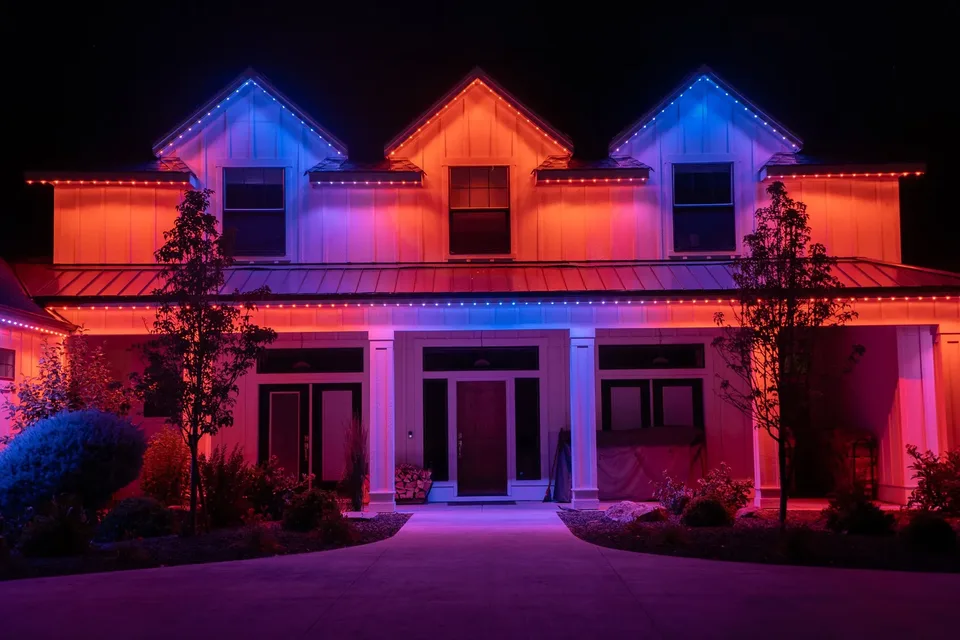
What does each one light?
Roofline lighting lights the edge of the roof. The lights face down inside a channel that follows the eave around every gable, peak and dormer, so after dark the shape of the house reads as one clean line from the street. Some of that light spills onto the siding and the shrubs just below, but its real job is the outline.
Landscape lighting works from the ground up. An uplight at the base of an old oak throws light into the canopy, a wash fixture brings out the texture of a stone wall, and path lights mark the walk from the drive to the front door. Its job is everything around the house: the trees, the beds, the steps and the face of the walls.
Where does each one mount?
Roofline lighting goes on the house itself. Our system mounts as an aluminum channel, color-matched to the trim and fastened to the fascia or the soffit, with the lights seated inside it and a single controller indoors. On an average house the job runs 8 to 10 hours, and licensed, insured and certified installers handle every step. The channel, the lights and the controller are all shown up close on the system page.
Landscape lighting goes into the yard. Fixtures are staked into beds or set at the base of trees and walls, and cable runs under the mulch back to a transformer, often mounted on an outside wall. It is a trade of its own, with its own designers and installers, and its layout is planned around plantings that grow and change from one year to the next.
How does each one look by day?
By day, the roofline channel reads as trim. It is matched to the color of the fascia, the lights sit up inside it facing down, and from the curb it is a thin line under the eave rather than anything that looks like a string of lights. Nothing comes down in January, because nothing was hung in the first place.
Landscape fixtures stay small and low, set in among the boxwoods, hostas and liriope, so in daylight most of them disappear into the beds. Put the two together and a well-lit house can look as though nothing was added to it at all, right up until the sun goes down.
What happens at the holidays?
This is where the two part ways most clearly. Landscape lighting is usually warm white, picked to flatter stone, brick and bark, and it tends to stay that way all year.
The roof edge is the piece of the house that follows the calendar. For Christmas it runs red and green, and through the rest of the year it can hold a palette for each holiday from Valentine's Day to New Year's Eve, then go back to warm white the next evening. Every one of those looks comes out of the same run of lights, and the full range is on the colors page. For the season itself, see how permanent Christmas lights in Nashville replace the yearly climb with a setting on a phone.
Together the two make a strong December picture. Red and green trace the roof above, warm white holds the trees and the walls below, and the color has something calm to sit on instead of floating over a dark yard.
How is each one controlled?
Roofline lighting runs from an app. The house is divided into zones that each run a scene of their own at once, so the front gables can show a color while the porch keeps warm white. Schedules and a sunset timer bring it on without anybody touching a phone, and it answers to Alexa, Google Assistant and Siri. For what a roofline on a timer uses, see electricity use in kWh for permanent house lights in Nashville.
Landscape lighting usually runs from its transformer, switched on and off by a timer or a dusk sensor. Set both to come on at dusk and the whole property lights up together: the outline first catches the eye, then the trees, the walk and the walls fill in around it.
Why do so many large Nashville homes run both?
Large houses in Belle Meade, Brentwood and Green Hills tend to sit well back from the road, behind mature trees, stone walls and long drives. At that distance, lit trees and a lit walk set the scene, but the roof edge is the longest line the house has, and after dark it is the line that tells a passer-by where the house actually is.
Roofline lighting draws that line. Landscape lighting fills in what stands in front of it. One gives the house its outline and the other gives the grounds their depth, and neither reaches into the other's job. A house that already has its trees and walls lit is often the best canvas for a roofline run, because the warm white below gives the color above a frame.
Bigger houses also bring more roofline: more gables, longer wings and sometimes a detached garage, all of which shape how the zones and controllers are laid out. That side of the work is covered in detail on the page about permanent lighting for large homes.
Add the roofline to the picture
If the trees and the walk are already lit, the roof edge is the piece still missing after dark. Tell the installers about the house on the quote form, and the free estimate comes back with a roofline run planned around it.