How many kWh does a permanent roofline use a night?
For a 150 ft roofline on colors and patterns for 6 hours, the calculation gives 0.81 kWh at Mid density, and 0.41 to 1.22 kWh across the published range. At full white, Mid comes to 1.08 kWh.
Kilowatt-hours a night, a season and a year for a roofline of permanent lights, worked out from the watts manufacturers publish and Naval Observatory sunset times for Nashville. Calculated from published specs, not measured at a home.
A 150 ft permanent roofline on colors and patterns uses 0.81 kWh a night, 34 kWh across the 42-night holiday season from November 25 to January 5, and 296 kWh over a full year on a 6 hour timer.
Based on 1.2 watts for each foot of roofline at full white, run at 75 percent for colors and patterns (an assumption). Across the published range of bulbs, the same 150 ft year runs 148 to 443 kWh. How the numbers are built.
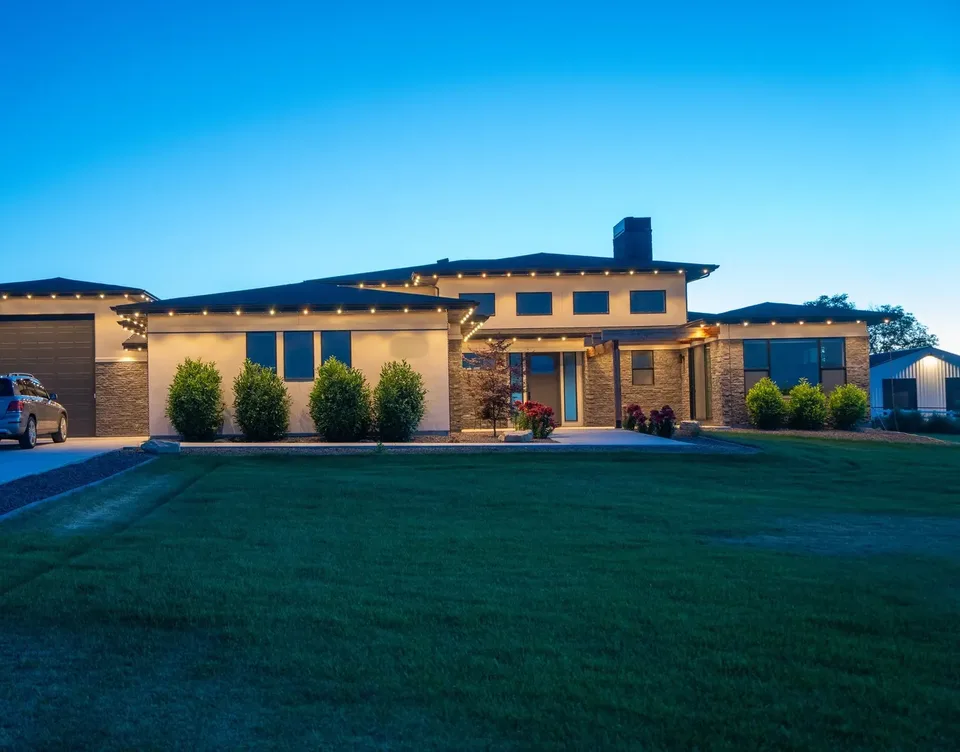
Permanent Lighting Solutions calculated that a 150 ft permanent roofline on colors and patterns, run 6 hours a night, uses 0.81 kWh a night in Nashville: 34 kWh over a 42-night holiday season and 296 kWh over a full year. The figures come from published bulb specs, not a measured home, and were updated October 6, 2026.
Change any setting and the figures recalculate. It opens on the same 150 ft example as the short answer above.
For these settings
296kWh a year
Not your exact roofline? Your estimate is measured on the house itself.
Get A Free Lighting Estimate| Season | Nights | Share of the year | kWh |
|---|---|---|---|
| Winter | 90 | 73 | |
| Spring | 92 | 75 | |
| Summer | 92 | 75 | |
| Fall | 91 | 74 |
Every figure on this page comes from five inputs and one line of arithmetic. The results are calculated from published specs, not measured at a home.
Download the data as CSV (kwh-tables.csv, free). Licensed under CC BY 4.0: reuse it with a credit to Permanent Lighting Solutions and a link to this page.
The arithmetic
feet × watts in each foot × brightness share = watts
watts × hours ÷ 1,000 = kWh a night
kWh a night × nights = kWh for the season or year
Dusk to dawn uses each season's own hours, so a year is the four seasons added together.
| Tier | Watts in each foot, full white | Published figures that land here |
|---|---|---|
| Low | 0.6 | 0.6 W bulbs at 12 inch spacing |
| Mid | 1.2 | 0.6 W bulbs at 6 inch, or 0.9 W bulbs at 9 inch. One maker's average home, 150 lights at 1 W on 117 ft, works out to 1.28 |
| High | 1.8 | 0.9 W bulbs at 6 inch spacing |
Calculated from the stated watts for each bulb and the stated spacing. Each maker's figure and link is in what manufacturers publish.
| Setting | Share of full white | Basis |
|---|---|---|
| Full white | 100% | The manufacturers' stated draw |
| Colors and patterns | 75% | 25 percent less, the low end of one maker's stated 25 to 60 percent saving |
| Dim accent | 40% | 60 percent less, the high end of the same statement |
One manufacturer's statement, quoted in the published watts table. Not independently measured, and the weakest input on this page.
What each part of the system is, from the track to the controller, is on what goes on the house. The colors and patterns themselves can be tried on the presets.
At full white, the published range puts a 150 ft roofline between 90 and 270 W. Six hours of colors and patterns on that roofline comes to 0.41 to 1.22 kWh a night.
| Roofline | Low 0.6 W in each foot | Mid 1.2 W in each foot | High 1.8 W in each foot |
|---|---|---|---|
| 100 ft | 60 | 120 | 180 |
| 150 ft | 90 | 180 | 270 |
| 200 ft | 120 | 240 | 360 |
Assumes: full white, watts in each foot as shown in the column heads.
| Roofline | Low | Mid | High |
|---|---|---|---|
| 100 ft | 0.27 | 0.54 | 0.81 |
| 150 ft | 0.41 | 0.81 | 1.22 |
| 200 ft | 0.54 | 1.08 | 1.62 |
Assumes: 6 hours a night, 75 percent brightness (an assumption), Low 0.6, Mid 1.2, High 1.8 watts in each foot.
| Roofline | Low | Mid | High |
|---|---|---|---|
| 100 ft | 0.36 | 0.72 | 1.08 |
| 150 ft | 0.54 | 1.08 | 1.62 |
| 200 ft | 0.72 | 1.44 | 2.16 |
Assumes: 6 hours a night at full white, the ceiling for each tier.
On a dusk to dawn setting, the lights run as long as it is dark. An average Nashville winter night is 13.82 hours of darkness and an average summer night is 9.83, so the same lights use about 1.41 times the kWh on a winter night, roughly 41 percent more. December against June is 1.52 times. A fixed 6 hour timer removes the gap.
Hours of darkness on the 15th of each month of 2026, 24 hours less the time from that day's sunrise to sunset, U.S. Naval Observatory, weighted by the days in each month. The bars are drawn against a full 24 hours.
| Season | Dark hours | kWh a night, dusk to dawn100 / 150 / 200 ft | kWh a season, dusk to dawn100 / 150 / 200 ft | kWh a season, 6 hours100 / 150 / 200 ft |
|---|---|---|---|---|
| Winter 90 nights | 13.82 | 1.24 / 1.87 / 2.49 | 112 / 168 / 224 | 49 / 73 / 97 |
| Spring 92 nights | 10.95 | 0.99 / 1.48 / 1.97 | 91 / 136 / 181 | 50 / 75 / 99 |
| Summer 92 nights | 9.83 | 0.88 / 1.33 / 1.77 | 81 / 122 / 163 | 50 / 75 / 99 |
| Fall 91 nights | 12.69 | 1.14 / 1.71 / 2.28 | 104 / 156 / 208 | 49 / 74 / 98 |
Assumes: Mid, 1.2 watts in each foot; 75 percent brightness (an assumption); 100, 150, 200 ft rooflines.
| Month | Dark hours | kWh dusk to dawn | kWh at 6 hours |
|---|---|---|---|
| Jan | 14.02 h | 59 | 25 |
| Feb | 13.10 h | 50 | 23 |
| Mar | 12.05 h | 50 | 25 |
| Apr | 10.88 h | 44 | 24 |
| May | 9.92 h | 42 | 25 |
| Jun | 9.38 h | 38 | 24 |
| Jul | 9.63 h | 40 | 25 |
| Aug | 10.47 h | 44 | 25 |
| Sep | 11.60 h | 47 | 24 |
| Oct | 12.72 h | 53 | 25 |
| Nov | 13.75 h | 56 | 24 |
| Dec | 14.28 h | 60 | 25 |
Year total: 582 kWh dusk to dawn, 296 kWh at 6 hours. The rounded months do not add up exactly. Assumes: 150 ft, 1.2 watts in each foot, 75 percent brightness (an assumption), every night of each month.
At 150 ft and Mid density, holiday only is 34 kWh, against 296 kWh for a year on a 6 hour timer, or 582 kWh dusk to dawn. Holiday only means 42 nights, November 25 to January 5. Year-round means all 365.
| Roofline | Holiday6 h | Year6 h | Yeardusk to dawn |
|---|---|---|---|
| 100 ft | 11 | 99 | 194 |
| 150 ft | 17 | 148 | 291 |
| 200 ft | 23 | 197 | 388 |
Holiday dusk to dawn (14.17 h): 100 ft 27, 150 ft 40, 200 ft 54 kWh.
| Roofline | Holiday6 h | Year6 h | Yeardusk to dawn |
|---|---|---|---|
| 100 ft | 23 | 197 | 388 |
| 150 ft | 34 | 296 | 582 |
| 200 ft | 45 | 394 | 776 |
Holiday dusk to dawn (14.17 h): 100 ft 54, 150 ft 80, 200 ft 107 kWh.
| Roofline | Holiday6 h | Year6 h | Yeardusk to dawn |
|---|---|---|---|
| 100 ft | 34 | 296 | 582 |
| 150 ft | 51 | 443 | 873 |
| 200 ft | 68 | 591 | 1,164 |
Holiday dusk to dawn (14.17 h): 100 ft 80, 150 ft 121, 200 ft 161 kWh.
Table F. kWh for the holiday season or the year. Assumes: 75 percent brightness (an assumption); holiday only is 42 nights, year-round 365; dusk to dawn uses Nashville's season hours, averaging 14.17 hours over the holiday nights.
| Brightness | A night | Holiday42 nights | Year365 nights |
|---|---|---|---|
| Full white 100% | 1.08 | 45 | 394 |
| Colors and patterns 75% | 0.81 | 34 | 296 |
| Dim accent 40% | 0.43 | 18 | 158 |
Assumes: 150 ft, 1.2 watts in each foot, 6 hours a night. The 75 and 40 percent rows rest on the brightness assumption.
2.7 percent of the 10,791 kWh an average US home bought in 2022 (EIA) is what 150 ft at Mid uses year-round on a 6 hour timer. Dusk to dawn, 5.4 percent. This is a national average, not a Nashville one.
1,552 kWh, or 14.4 percent of that average, is the ceiling in these tables: 200 ft, High, full white, dusk to dawn every night of the year.
34 kWh for a 150 ft holiday season on a 6 hour timer, against 44.6 kWh for one 6 ft tree of 600 incandescent lights lit 6 hours a night through December (240 W, EnergySage).
Multiply the kWh on this page by Nashville Electric Service's cents per kWh for the month, as shown below; what the lights cost to put up is on the pricing page. NES charges homes for energy in cents per kWh, at a rate that changes with the season, plus a fuel cost adjustment that changes each month.
NES adds a fuel cost adjustment to every kWh. NES sets it each month and lists it on its monthly fuel cost sheet.
The monthly service charge on an NES bill is fixed. The TVA grid access charge is tiered on a home's average monthly kWh over the latest 12 months, lower at or below 500 kWh and higher above it. Lights move that charge only if they push the average across that line, so neither has a place in a kWh figure.
Current rates are on NES's rates page. What the lights themselves cost to put up is on the pricing page.
Side by side, the published per-bulb specs span a threefold range: from 0.6 to 1.8 watts in each foot at full white, so a 150 ft roofline draws between 90 and 270 W. One maker publishes only a rated supply wattage, which works out to 0.54 W in each foot as a ceiling, not a full-white draw, so it sits outside that range. The right-hand column is this page's arithmetic on each stated figure.
| Source | Stated | Spacing | Watts in each foot, calculated here |
|---|---|---|---|
| Trimlight Classic | 0.6 W a bulb, 1 LED | 6, 9 or 12 inch | 1.2 at 6 in, 0.8 at 9 in, 0.6 at 12 in |
| Trimlight 3L | 0.9 W a bulb, 3 LEDs | 6, 9 or 12 inch | 1.8 at 6 in, 1.2 at 9 in, 0.9 at 12 in |
| Trimlight Commercial | 1 W a bulb, 3 LEDs | 12 inch | 1.0 |
| Trimlight FAQ | 0.9 W (3L) and 0.6 W (Classic) a bulb | Not stated | Cross-check of the two figures above |
| Gemstone Lights track system | "At maximum capacity ... 1 watt/bulb"; an average home with 117 linear feet of roofline needs 150 lights | 150 lights on 117 ft | 1.28 (1 W times 150, divided by 117) |
| Gemstone Lights, same page | Most customers pick a colored or architectural pattern, "using 25% to 60% less power" than full bright white | Not applicable | Source of the 75 and 40 percent brightness assumptions |
| Govee Permanent Outdoor Lights H706C | 108 watts, 200 ft, 120 lights | 120 lights on 200 ft | 0.54 (108 divided by 200); a rated supply wattage, so a ceiling |
| JellyFish Lighting | "less than one watt per light at the brightest white" | Not stated | Not derived: light spacing is not published |
| Oelo | ".07 watts per LED" | LEDs in a light and spacing not found | Not derived: LED count and spacing are not published |
Watts in each foot are calculated from the stated watts for each bulb times the bulbs in each foot at the stated spacing. A rated power supply sets a ceiling, not a draw. Rows without a spacing or a light count cannot be turned into watts in each foot and are shown as stated.
Every figure here is the LED load alone. Use at the wall socket is a little higher, and no source fetched gives a figure for how much, so none is added.
A power supply converts house current for the lights, and loses some energy doing it.
A controller on Wi-Fi can draw a little power while the lights are off. No source fetched for this page gives a figure.
These tables count night hours only. Lights run in daylight add to the total at the same watts.
For a 150 ft roofline on colors and patterns for 6 hours, the calculation gives 0.81 kWh at Mid density, and 0.41 to 1.22 kWh across the published range. At full white, Mid comes to 1.08 kWh.
One manufacturer states that colored or architectural patterns use 25 to 60 percent less power than full bright white. That is a manufacturer's claim, not a measurement, and this page's 75 and 40 percent settings are built on it.
Yes. A Nashville winter night averages 13.82 hours of darkness against 9.83 in summer, so 150 ft at Mid uses 1.87 kWh on a winter night and 1.33 on a summer one. A fixed timer uses the same amount every night.
A string of 100 incandescent mini-lights draws 40 W, and a 6 ft tree of 600 of them lit 6 hours a night through December uses 44.6 kWh (EnergySage inputs). A 150 ft permanent roofline on colors and patterns uses 34 kWh across a 42-night holiday season. Permanent lights against seasonal ones covers the rest of that choice, and the FAQ on running cost has the short version.
Thinking about permanent lights for your own roofline? See the Nashville-area towns we serve.