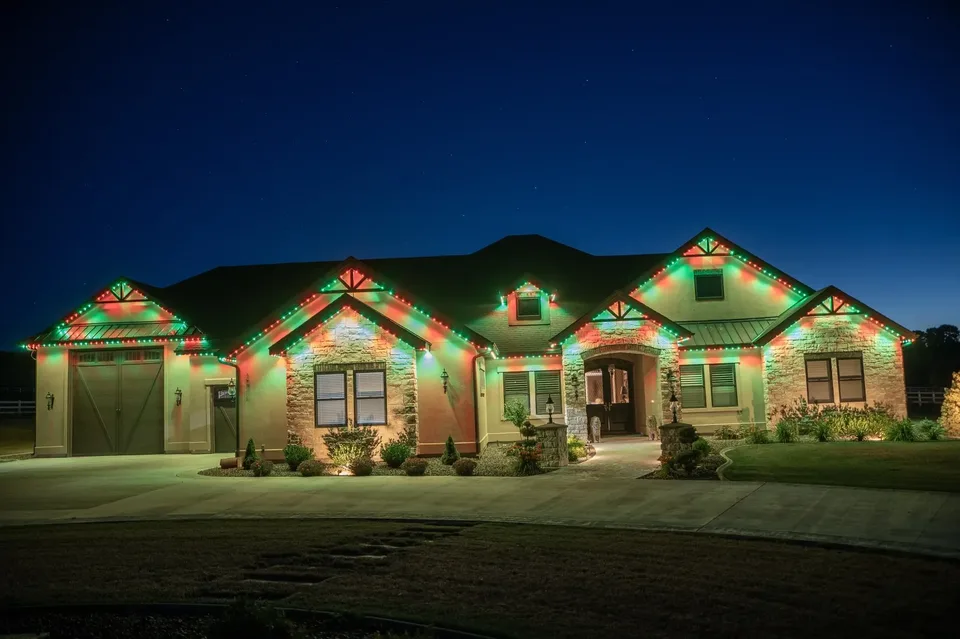
If you live in Green Hills, Oak Hill, Brentwood, Belle Meade, Franklin or Forest Hills and want your roofline lit this season, you have two ways to go. One is a seasonal strand install that comes down in January. The other is a permanent channel system that stays up all year. This guide covers what to ask any installer, how the two differ, what install day looks like, and what the houses in each town mean for a lighting plan.
Questions to ask any installer
Whoever you hire, these questions tell you a lot:
- Who will be on my roof? Ask whether the people on the ladders work for the company you are hiring, and whether they are licensed and insured.
- What is covered, and by whom? Ask for the product coverage and the installation coverage in writing, and how long each one lasts.
- How was my roofline measured? A plan built from your own house is worth more than a figure given without seeing it.
- Where does it attach? Ask what gets fastened to the house and whether anything passes through the gutter or the roofing.
- Where does the controller go? Ask where it will be mounted and how it gets power.
- What does the app cost to use? Ask whether there is a monthly or yearly fee.
- What happens if something stops working? Ask who you call and what happens next.
Seasonal strands and permanent channel lighting
A seasonal install means strands fastened along your fascia in late autumn and removed in January, and the job repeats every year.
Permanent lighting works differently. The lights sit in a channel that is color-matched to your fascia or trim before it is ordered, and they face down, so the hardware stays out of sight. Each light has a dedicated white diode alongside its color diodes, and brightness is adjustable.
You run it from an app on iOS or Android. It has recurring schedules and sunrise and sunset timers, and you can book holiday looks weeks ahead. The schedule lives on the controller, so it keeps going when your phone is away from home. There are 256 preset scenes, you can save your own, and there is no monthly or annual app fee. One controller runs up to 8 zones, each with its own scene at the same time, and up to 4 controllers can share one account.
Care is simple: rinse the lights when you rinse the gutters. The components are UL rated. At 6 to 12 hours a day, the system works out to about 10 to 20 years.
What install day looks like
Plan on 8 to 10 hours for an average install; the size of the job is what moves that number. The channel color is matched to your trim before it is ordered, so the installers arrive with it ready. The controller usually goes indoors, often in the garage near where the light runs enter.
A few things make the day go smoothly:
- Move cars out of the driveway so ladders can go where they need to.
- Tell the installers about pets, gates and any outdoor outlets they should not use.
- Before they leave, have them show you the app on your own phone.
Two story houses raise their own questions about ladders and reach; see Christmas lights on a two story house.
The houses in each town
Brentwood
How much roofline will the street actually see from a big Brentwood lot? In neighborhoods such as Brenthaven and Indian Point, the houses are detached single-family homes on lots of at least one acre, set well back from the road. On a lot that size, the roofline is what carries your lights to the street.
Belle Meade
Which run suits a Belle Meade house? That depends on its style. Most of the older homes here, built between 1910 and 1930, are Neo-classical, Colonial Revival, Georgian Revival or Tudor Revival, and Ranch houses followed in the 1950s and 1960s. A steep Tudor gable and a long, level Colonial Revival eave need different runs, so a good plan follows each one.
Franklin
Will a Queen Anne house take a simple straight run? Rarely. Queen Anne houses have steeply pitched roofs of irregular shapes, so the lights have to turn with every gable and bump-out. Walk the house with your installer and agree on where each section starts and stops.
Forest Hills
Which gables should the street see? Forest Hills has a number of Tudor Revival houses, among them the 1931 Richard E. Martin House and the P.D. Houston Jr. House. Tudor rooflines have many gables and breaks, so it pays to decide which of them the street can actually see.
Green Hills
Green Hills filled in mostly after World War II, and much of the housing from those years is brick-veneer ranch houses on large lots. A ranch has a wide, low front eave, so one even run across it carries the look to the street. The older English-style houses from the 1920s are a different job, because their roofs break into gables and the run has to follow each break. By day the install is basically invisible. No ugly holiday lights hanging all year.
Oak Hill
Oak Hill is a city of large, tree-filled lots, and many houses sit well back from the road behind trunks and branches. Trees can hide long stretches of roofline from the street, so mark the roof edges the road can actually see through them and light those first. By day the channel matches your trim and the trees keep the attention.
Working with us
Permanent Lighting Solutions is veteran-owned, and every job is done by licensed, insured and certified installers. Our installers put in permanent roofline lighting across Nashville and the towns above. Each system is covered by the manufacturer's 5-year product warranty and our installers' workmanship warranty. Financing is available, ask in your quote request.
When you are ready, send the quote form. An installer will call you, and your free estimate follows.